Resume Job-Match Scores: refresh.cv vs Jobscan, Teal, Rezi

A resume job-match score can measure two different things: how closely your resume's keywords match a specific job posting, or how well the resume itself is written. This comparison checks refresh.cv, Jobscan, Teal, and Rezi against four criteria: what each score measures, whether it is separated from a writing-quality score, whether it distinguishes real experience from bare keywords, and how much you can see for free. None of the four scores is an official ATS verdict, so the most practical use of any of them is deciding what to fix next.
We build refresh.cv, an AI resume tool, and our own product is one of the four tools in this comparison. We applied the same four criteria to every tool and pulled feature details from each site's official pages and help docs. Where we could not confirm a feature in official documentation, the table below says so.
Before comparing scores, one fact is worth stating plainly: none of these numbers comes from an employer's actual ATS. Jobscan's resume scanner page explains that submitting an application does not cause an ATS to score your resume; its own match rate is a visualization tool meant to gauge a resume before you apply. Rezi's help docs make the same point: a real ATS does not issue an official score. Every score below is the output of that vendor's own formula.
Fit Score vs. Quality Score
A job-match score checks how much of a posting's required skills, titles, and keywords show up in your resume. Change the posting and the same resume gets a different score.
A quality score ignores the posting and evaluates the writing itself: specificity, achievement framing, sentence length, grammar, and format.
Mixing the two into one number makes it harder to know what to fix. A well-written resume can still be missing a posting's core requirements, while a keyword-heavy resume can score well on fit with bullets that carry no real evidence of impact. Jobscan's tutorial shows this split clearly: its match rate is calculated from hard skills, then degree (only when the posting requires a graduate degree), then job title, then soft skills, then other keywords, in that order. Word count and measurable achievements are excluded from the match rate itself; Jobscan surfaces them separately as report tips instead.
How Four Tools Compare
The table below lines up the same four criteria across refresh.cv, Jobscan, Teal, and Rezi.
| Criterion | refresh.cv | Jobscan | Teal | Rezi |
|---|---|---|---|---|
| Job fit | Compares a posting's duties, skills, and ATS keywords against your resume; flags what's met and what's missing | Match Rate (1-100%), 75%+ recommended | Match Score (0-100%), analyzes keywords, skills, and experience requirements | Rezi Score (1-100) is a resume readiness score; whether it is posting-specific is not established in Rezi's public docs |
| Separated from quality score | Resume score analysis (specificity, achievements, wording, grammar) is reported separately from job fit | Word count and measurable achievements are excluded from match rate and shown as separate report tips | Analyzer checks structure, impact, and keyword use across 15+ factors separately | Content, Format, Optimization, Best Practices, and Application Ready, 23 items combined into one score |
| Evidence distinction | Three states: keyword and evidence both present / experience present but keyword missing / neither present | Identifies missing keywords | Shows which posting keywords are included or missing | Not established in Rezi's public docs |
| What's free | Free plan includes 5 resume score analyses per month; job-specific tailoring and key-requirement analysis are Pro ($14.99/month) items | Check Jobscan's official pricing page | Job Matcher is free to use; the free tier shows only some keywords | Check Rezi's official pricing page |
Table sourced from refresh.cv, refresh.cv pricing, Jobscan's tutorial, Teal's official tool page, Teal's help center, and Rezi's help docs. Rezi's help article states directly that the Rezi Score is not an ATS score. Prices and limits change, so confirm current numbers on each official page before you pay for anything.
How We Read refresh.cv's Results
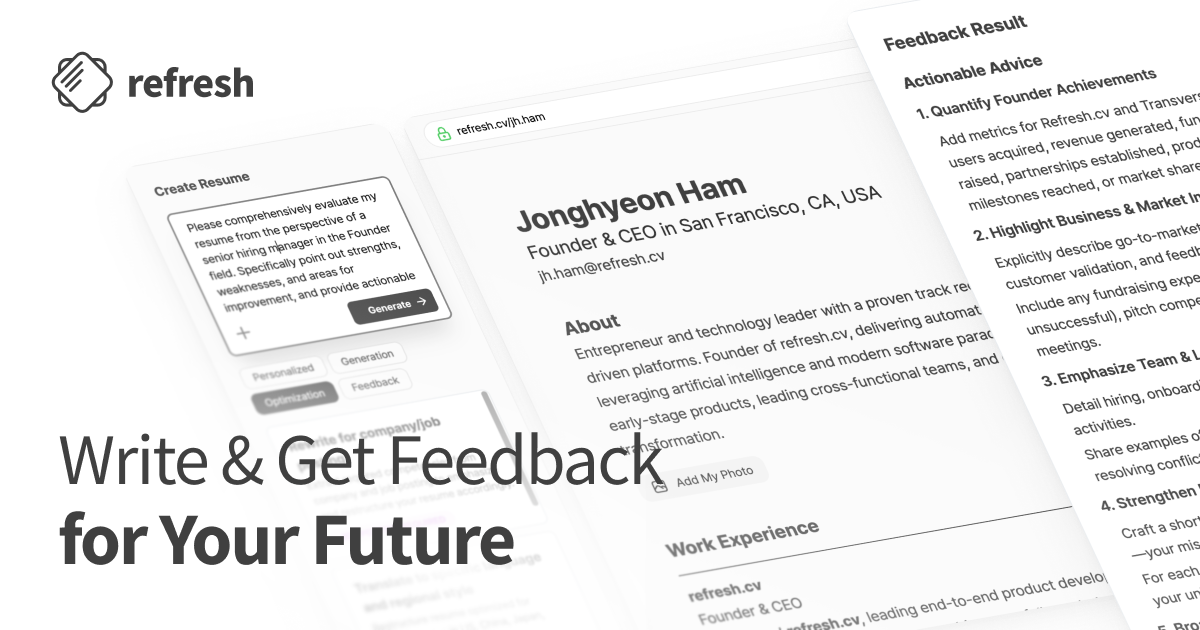
Our workflow runs: paste the job posting, extract its requirements and ATS keywords, compare your current resume's wording and experience against them, then confirm a revision priority order. On refresh.cv's homepage, the example results screen splits output into three groups: "ATS keywords with experience," "Experience without ATS keywords," and "No relevant experience found."
Here is a hypothetical example to show how that plays out. Say a product/service planning posting asks for user research, data analysis, onboarding improvement, and launch ownership.
- Keyword and evidence both present: a line like "Analyzed the signup funnel with SQL to find drop-off points" already states the data-analysis requirement and what you actually did. Keep it, and check only whether the quality score flags a missing outcome number.
- Experience present, keyword missing: you ran customer interviews but never wrote "user research." Fix this one first: restate the same real work in the posting's language, without claiming more than you did.
- Neither present: if you never owned a launch, don't add it to the resume. Move it to a separate list of things to be ready to discuss in an interview as a learning gap instead.
We do not prompt people to invent experience or pad keyword counts to move an item out of group 3. After the group-2 items are rewritten, we check the same sentences again through the resume score analysis for specificity and achievement framing. The refresh.cv pricing page lists 1 Mock Apply credit per month on Free and 10 per month on Pro; Mock Apply then serves as a supplementary check after that revision.
See our separate walkthrough on checking whether a resume passes ATS screening for the format side of this same diagnostic.
What the Score Doesn't Tell You
Recommended thresholds differ by vendor. Jobscan recommends a match rate above 75%; Rezi's docs describe 90+ as application-ready. The two numbers measure different things, so they cannot be ranked against each other.
The fastest way to raise a score is not always the most honest one. Teal's guide to tailoring a resume is direct about this: a high match score does not prove a recruiter will move you to the next round, and any suggested keyword belongs on the resume only when it truthfully describes real experience.
Choosing by Use Case
- Want one fast number for keyword match against a single posting? Jobscan's Match Rate report is built for that.
- Want job tracking and matching in the same place? Teal lets you match directly against postings saved in its Job Tracker (Teal's help center).
- Want a live score that updates as you edit? The Rezi Score refreshes with every edit.
- Want posting requirements checked against your actual experience, with a revision order attached and a quality score kept separate? That's what refresh.cv is built around.
For plan limits across these free tiers, see our comparison of AI resume pricing and free-plan caps.
FAQ
Should soft-skill keywords go on the resume too?
Tools disagree here. Jobscan includes soft skills in its match-rate calculation. Resume Worded's comparison of Jobscan and Resume Worded points out that Jobscan recommends adding soft skills like teamwork the same way it treats hard skills, and flags that as a caution from a recruiting standpoint. It is safer to use a soft-skill word only when an actual work sentence demonstrates it, rather than listing the word alone.
Should I change my job title to match the posting's title?
Jobscan recommends updating your resume title to the applied-for title when you've done similar work, and cites its own data showing resumes with an exact title match saw a 3.5x higher interview rate (Jobscan's tutorial). That figure is Jobscan's own internal data rather than an independent study, so treat it as one vendor's result. Consider the change only when your actual responsibilities matched the posting's scope.
How many keywords do I need to match?
There is no fixed number to hit. Fixing the items where you have real experience but missing wording is a better use of time than chasing a keyword count. Adding keywords without matching evidence can raise a fit score while leaving you with nothing new to explain in an interview.
Try It With Your Own Resume
Pick one job posting you're applying to and your current resume, then start at refresh.cv. The resume score analysis is free to run; if you need job-specific tailoring and key-requirement analysis, check the Pro tier on the pricing page.
0
Get new posts by email
Subscribe to get new articles on resumes, interviews, career moves, and career growth.