Meet refresh.cv: From Resume Templates to Mock Apply

Note: This is the story of why refresh.cv moved from resume templates to Mock Apply.
The core idea is simple. A better job search is not about sending more applications. It is about understanding how one application may be read before you send it.
refresh.cv did not start with Mock Apply.
We started by building better resume templates. We wanted candidates to create a cleaner resume, share it more easily, and avoid spending a whole day fighting document formatting.
But as we followed the moments where candidates actually got stuck, the problem moved beyond templates.
Key takeaways
- Agentic Resume Builder helps candidates turn scattered experience into stronger evidence. It is not about making a resume sound louder. It is about making the candidate's real work easier to understand.
- A resume is not judged by itself. A job posting, company context, level, and team focus all change which proof should move forward and which gaps become risky.
- Mock Apply is the final pre-application check. After improving the resume and choosing a real target in refresh.cv Jobs, Mock Apply shows how the resume, job posting, and candidate answers may be read together before the application is sent.
We first thought templates would be enough
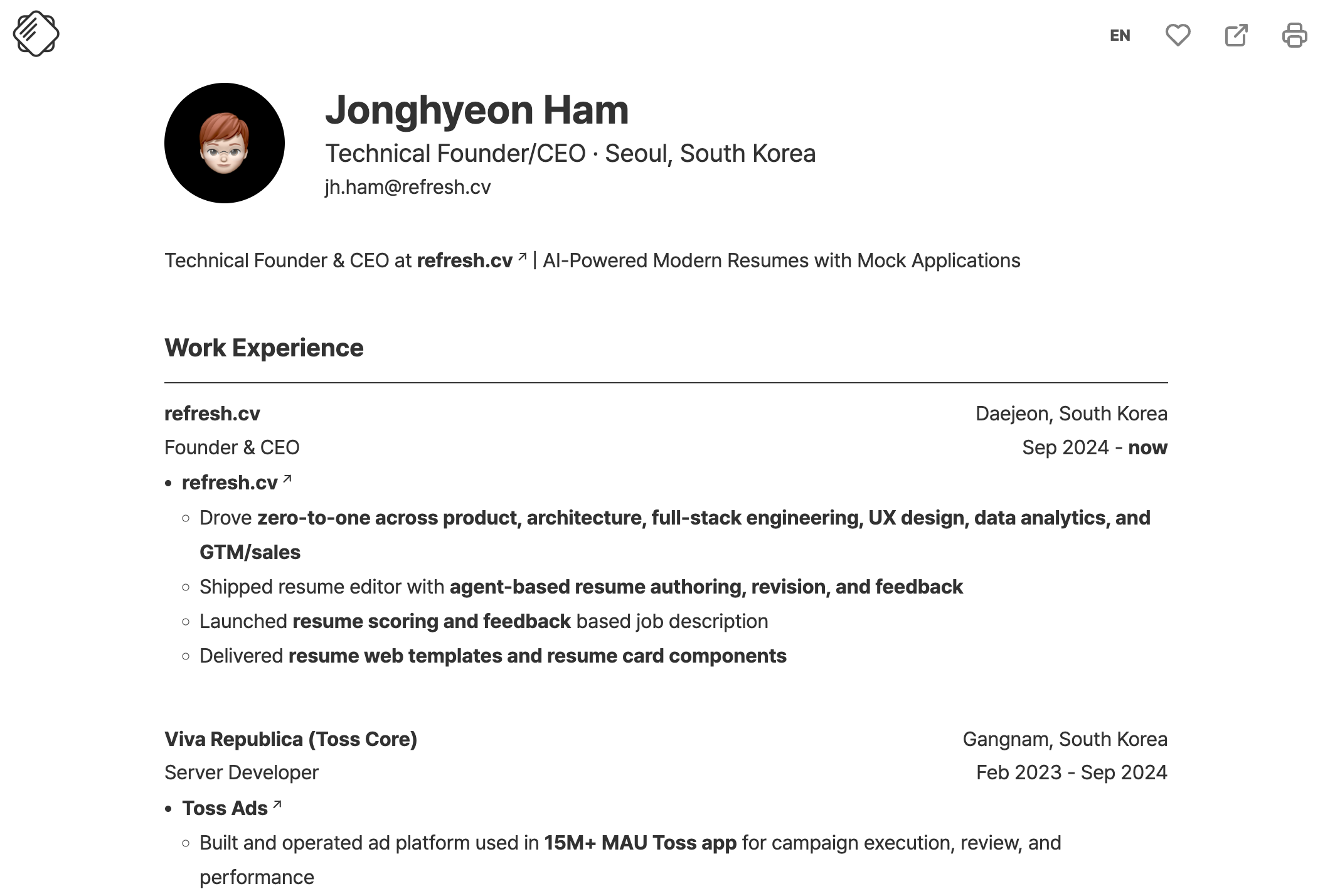
Good templates matter. They create structure, remove visual noise, and make a resume easier to scan.
But a clean template is not a strategy. It fixes the surface. It does not answer the question that decides whether the resume moves forward.
After reviewing resumes with candidates, we kept seeing the same pattern: the resume looked fine, but it did not give the reader enough evidence to say yes.
A hiring team is not reading your resume like a personal archive. They are testing risk.
- Can this person handle our scale?
- Have they seen this kind of system before?
- Did they own the work, or were they just nearby?
- If something failed, did they improve the process?
- Is this experience relevant to this role, or just generally impressive?
That is why the hard part was not section order. The hard part was knowing how the resume would be read for one specific role.
Imagine a backend engineer applying to a payments platform role at a fintech company. The job description asks for high-volume traffic, incident response, settlement data reliability, and security awareness.
The resume says:
Built and maintained payment APIs.
A mentor has to be honest here: this sentence is not wrong. It is worse than that. It is too easy to skip.
It names a task, but it does not give a signal. It does not tell the hiring team:
- what scale the API handled,
- what failure mode the candidate dealt with,
- what part they actually owned,
- what improved because of their work,
- or why a payments team should care.
If you make the reader infer all of that, most readers will not infer it in your favor. They will move on.
The same experience becomes stronger when it gives the reader something to judge:
Operated payment APIs handling [monthly request volume], improved retry behavior, and clarified alert thresholds so the team could respond to payment failures faster.
This is not dramatic writing. Once the candidate fills in the real value, it becomes better evidence. The sentence gives domain, scale, action, and result. A hiring manager can compare it to their own problem.
That is where the direction of refresh.cv started to change. A template can make a resume look finished. It cannot tell you whether the resume is ready for this job.
A resume is not the finish line
Most career tools treat the resume as the end product.
Write it, save it, export it, and send it.
But in a real hiring process, the resume is not the destination. It is the starting point for a decision.
Recruiters and hiring managers read a resume while asking:
- Can this person actually do the work?
- Is there evidence for the most important requirements?
- Does the impact look repeatable?
- What should we verify in the interview?
Candidates usually discover those questions too late. They submit the application, wait, and then try to guess why nothing came back.
We thought that order was wrong.
Before sending an application, candidates should be able to understand how it may be read.
So we built Agentic Resume Builder
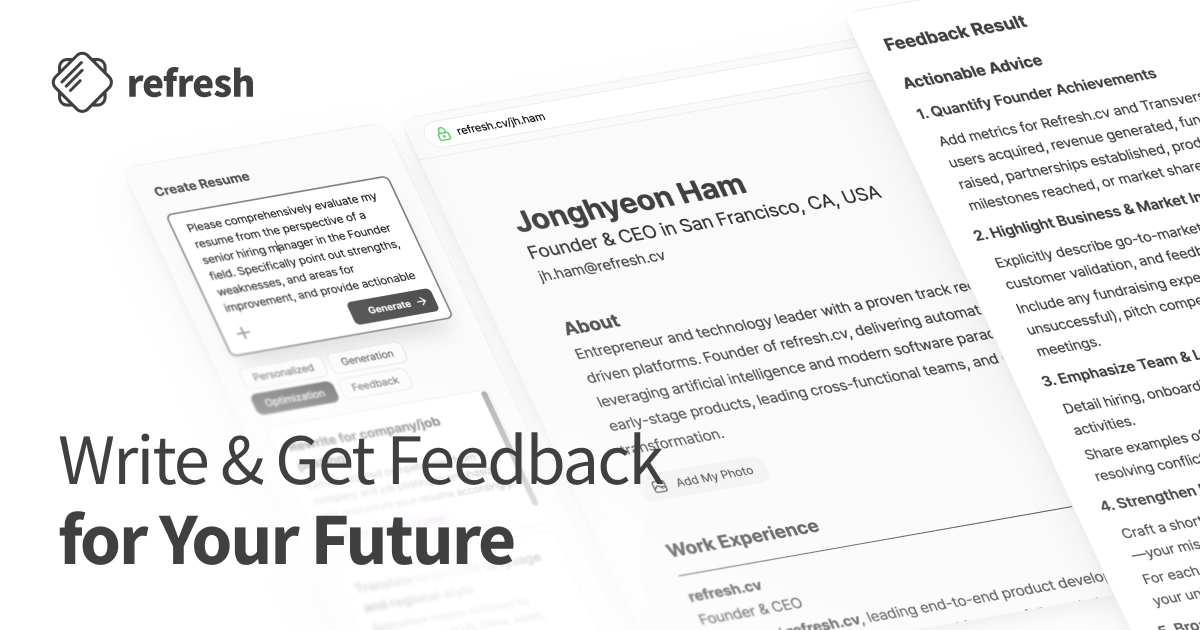
Agentic Resume Builder is not a blank AI chat box. It is a set of focused resume agents inside refresh.cv.
You can type your own request, or start from a predefined prompt. The agents can turn activity notes into resume content, extract portfolio work, write a profile summary, draft a cover letter, reframe a career switch, tailor the resume to a job posting, organize skills, check parsing, find missing keywords, turn responsibilities into impact, predict interview questions, review sensitive information, and adapt the resume for a country or hiring market.
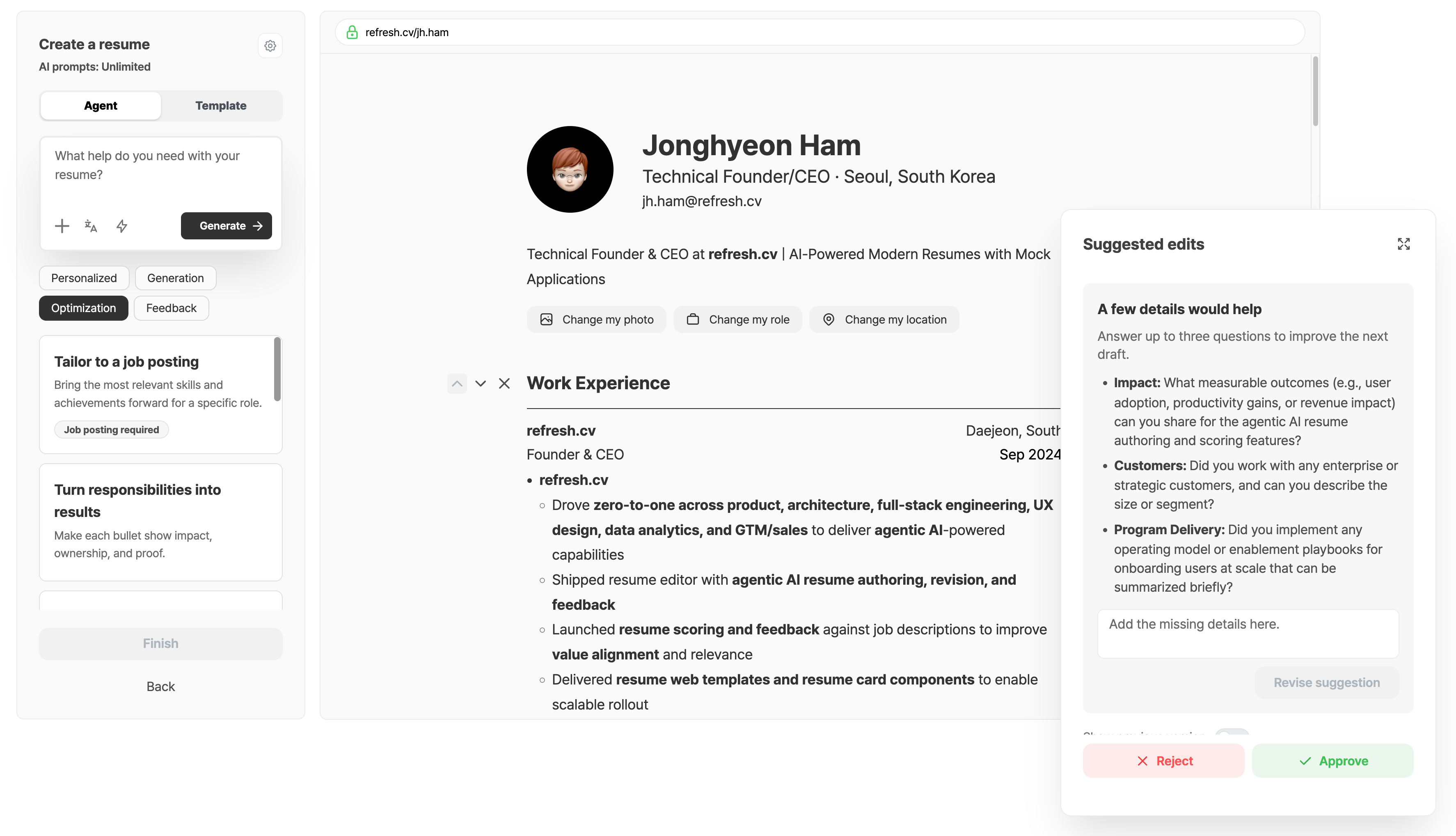
The point is not to let AI invent a career. It is to turn the material candidates already have into evidence a recruiter or hiring manager can evaluate.
With each response, the agent keeps asking for the candidate's own missing answers: scale, frequency, scope, constraints, trade-offs, outcomes, and what they personally owned. That is the difference between rewriting a resume and pulling out real evidence.
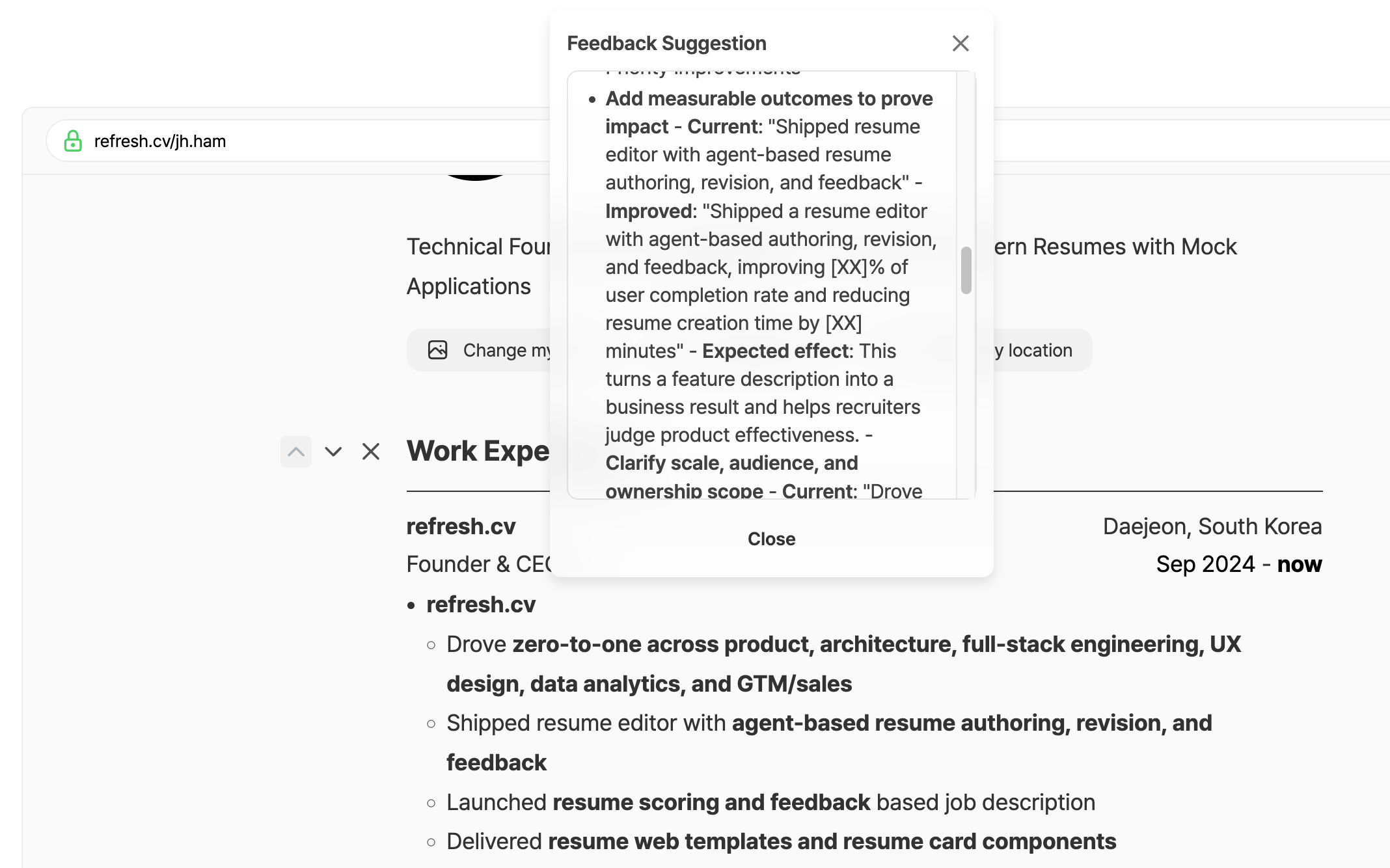
Quantitative metrics are handled carefully. refresh.cv does not invent numbers to make a bullet look stronger. If a value is missing, it leaves a placeholder such as [monthly request volume], [before/after result], or [team size] so the candidate can enter the real number themselves.
For example, imagine a backend engineer applying to a payment infrastructure role. A normal resume line might say:
Built and maintained payment APIs.
That is readable, but it does not answer the questions a hiring team will ask. What scale? What reliability problem? What changed because of the work? Did the candidate own design decisions, incident response, settlement data, or security constraints?
Agentic Resume Builder pushes the candidate toward the evidence a reviewer can actually evaluate:
Operated payment APIs handling [monthly request volume], improved retry behavior, and clarified alert thresholds so the team could respond to payment failures faster.
Once the candidate fills in the real number, that sentence is not just prettier. It is more useful. It gives the hiring team a reason to believe the candidate has worked on a problem close to the one in the job posting.
That is the practical point: turn vague work into evidence, but keep the missing facts honest until the candidate fills them in.
The product works better when this is not treated as a set of big feature cards. In practice, a candidate usually starts with one concrete resume task:
- Import experience from my activities: turn recorded work, project notes, and activity history into structured resume entries.
- Tailor to a job posting: adjust one resume against one real JD, so the right evidence appears earlier.
- Translate and adapt to a target market: rewrite the resume for a specific country, language, and hiring market, not just word-for-word translation.
- Get feedback from an industry expert: find the strongest evidence, risky claims, missing proof, and the first fixes for the target role.
Inside refresh.cv, candidates do not have to start from a blank chat box. They choose the resume work they need, then the agent keeps asking for the missing facts only the candidate can provide.
The full feature map is longer, but it is still organized around practical resume work:
| Feature | Description |
|---|---|
| Import experience from my activities | Turn activity records into structured resume entries with achievements, scope, and impact. |
| Import experience from files | Pull projects, accomplishments, and evidence from PDFs, decks, and other files, then draft resume entries from them. |
| Write my About section | Draft a concise introduction from the strongest parts of your resume. |
| Position for a career pivot | Reframe your experience for the role or field you want next. |
| Write a cover letter | Create a tailored cover letter for a specific company and role. |
| Prep likely interview questions | Use your resume and the job posting to draft likely questions and talking points. |
| Tailor to a job posting | Bring the most relevant skills and achievements forward for a specific role. |
| Turn responsibilities into results | Make each bullet show impact, ownership, and proof. |
| Make my strengths easier to spot | Move the most relevant experience and achievements where recruiters see them first. |
| Organize skills for this role | Put the most relevant skills where recruiters can find them fast. |
| Translate and adapt to a target market | Translate the resume and adapt the wording, format, and conventions for a specific language, hiring market, and field. |
| Make the writing sound more professional | Make experience and achievement bullets clearer, sharper, and more credible. |
| Remove repetitive wording | Find repeated words and sentence patterns, then vary the writing so it reads more naturally. |
| Fix grammar and mechanics | Correct spelling, grammar, and punctuation throughout your resume. |
| Get feedback from an industry expert | Get expert feedback on structure, achievements, and positioning. |
| Check resume parsing | Find formatting issues that could cause job sites or screening tools to miss important details. |
| Find achievements I can make more concrete | Spot where numbers, scale, or proof would make achievements stronger. |
| Find missing role keywords | Show which important keywords are already present and which ones are still missing. |
| Review sensitive personal and career information | Flag personal or sensitive details before you publish, and suggest safer wording. |
This is why we call it agentic. The product is not trying to be a magic writer. It gives the candidate a set of narrow, practical resume agents, each aimed at the question that matters before applying: what will this resume make the hiring team believe?
Want to try Agentic Resume Builder?
Create or import your resume, choose the resume work you need, and let refresh.cv help you write, organize, translate, or review it with focused agents.
A better resume still did not solve the whole job search
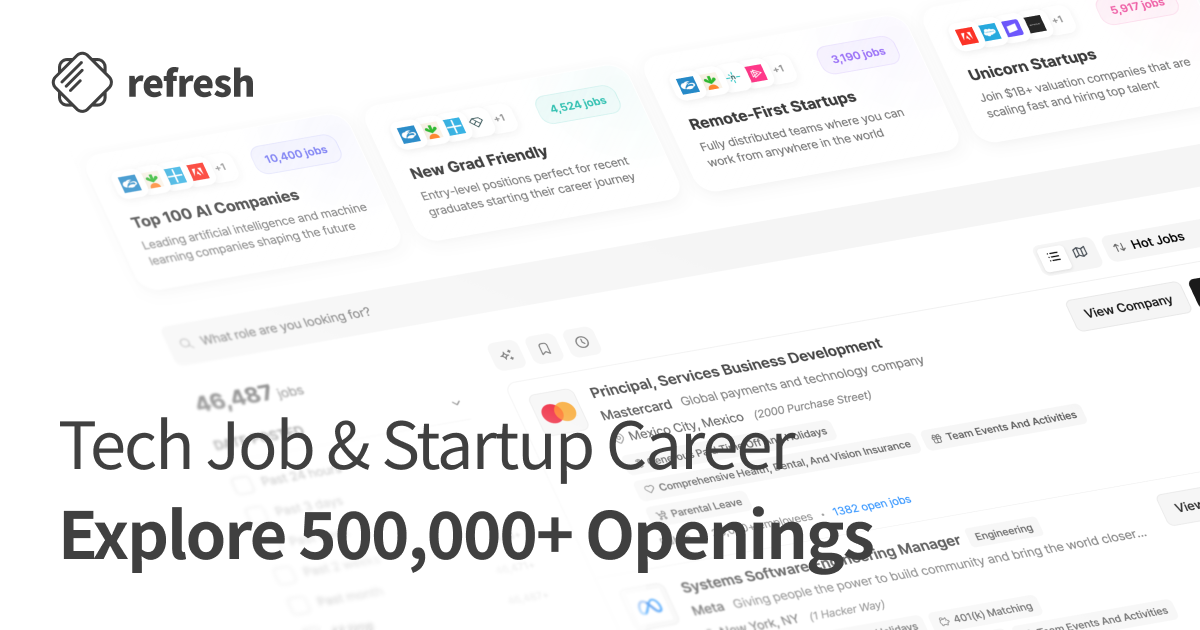
As more people used Agentic Resume Builder, a second problem became obvious.
Even candidates with a stronger resume still paused at the same question:
Should I apply to this role right now?
That question cannot be answered by the resume alone. Candidates also need to understand the job, the company, the team, and whether their evidence fits the actual role.
That is why we started building Jobs & Company Intelligence.
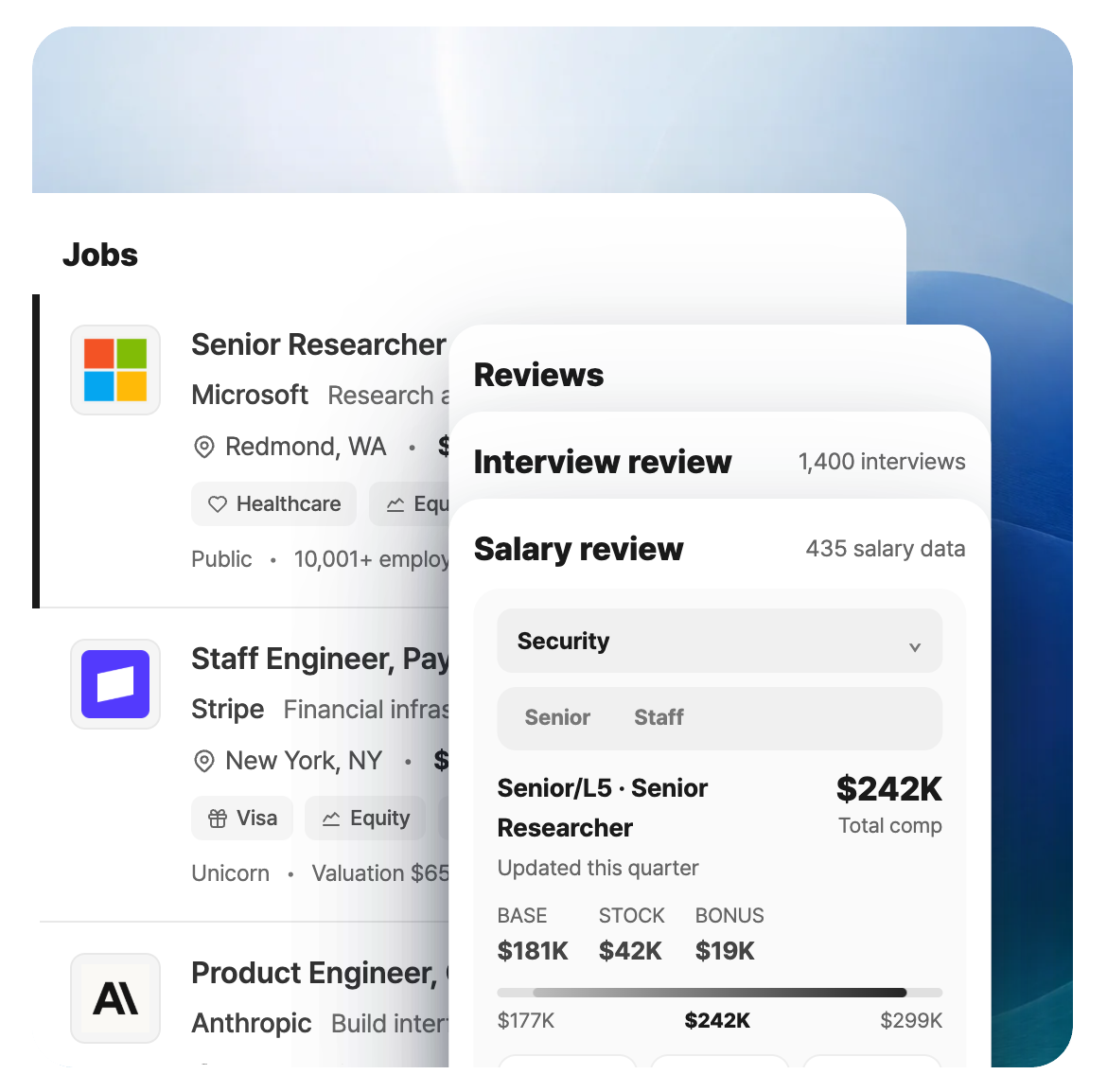
refresh.cv Jobs is not designed as another infinite list of job cards. The goal is not to make candidates scroll through hundreds of thousands of postings. The goal is to help them find better matches faster, then decide whether a role is worth tailoring for.
1. Find better matches, faster
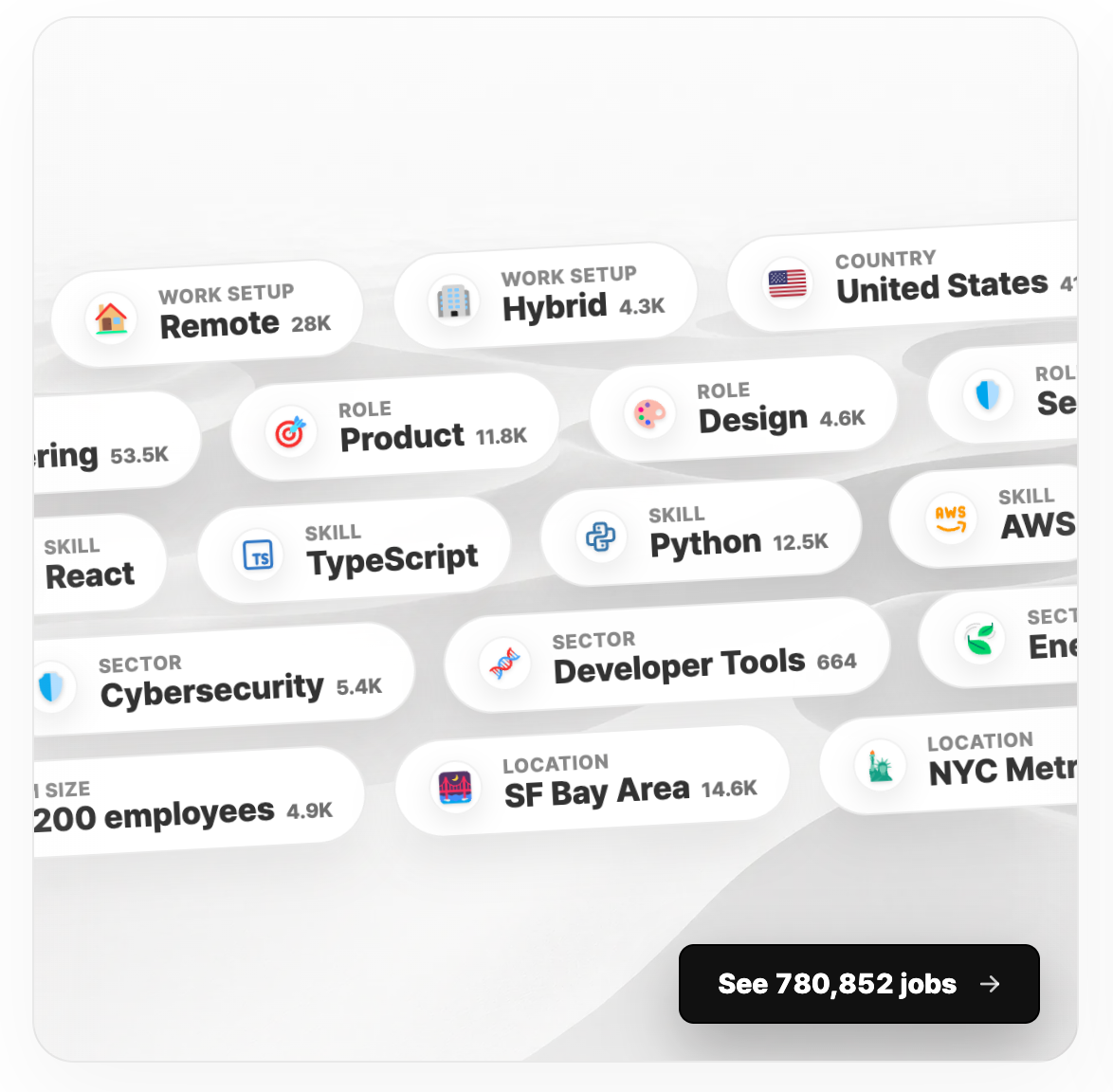
Filters should protect the candidate's time, not make the search page look busy.
Before rewriting a resume, the target market should already be narrow: role, level, location, work setup, visa support, salary, equity, company stage, funding, team size, and skills.
A resume gets sharper only after the target is specific. First choose the roles you can plausibly win, then decide what proof the resume must lead with.
2. Know the company before you apply
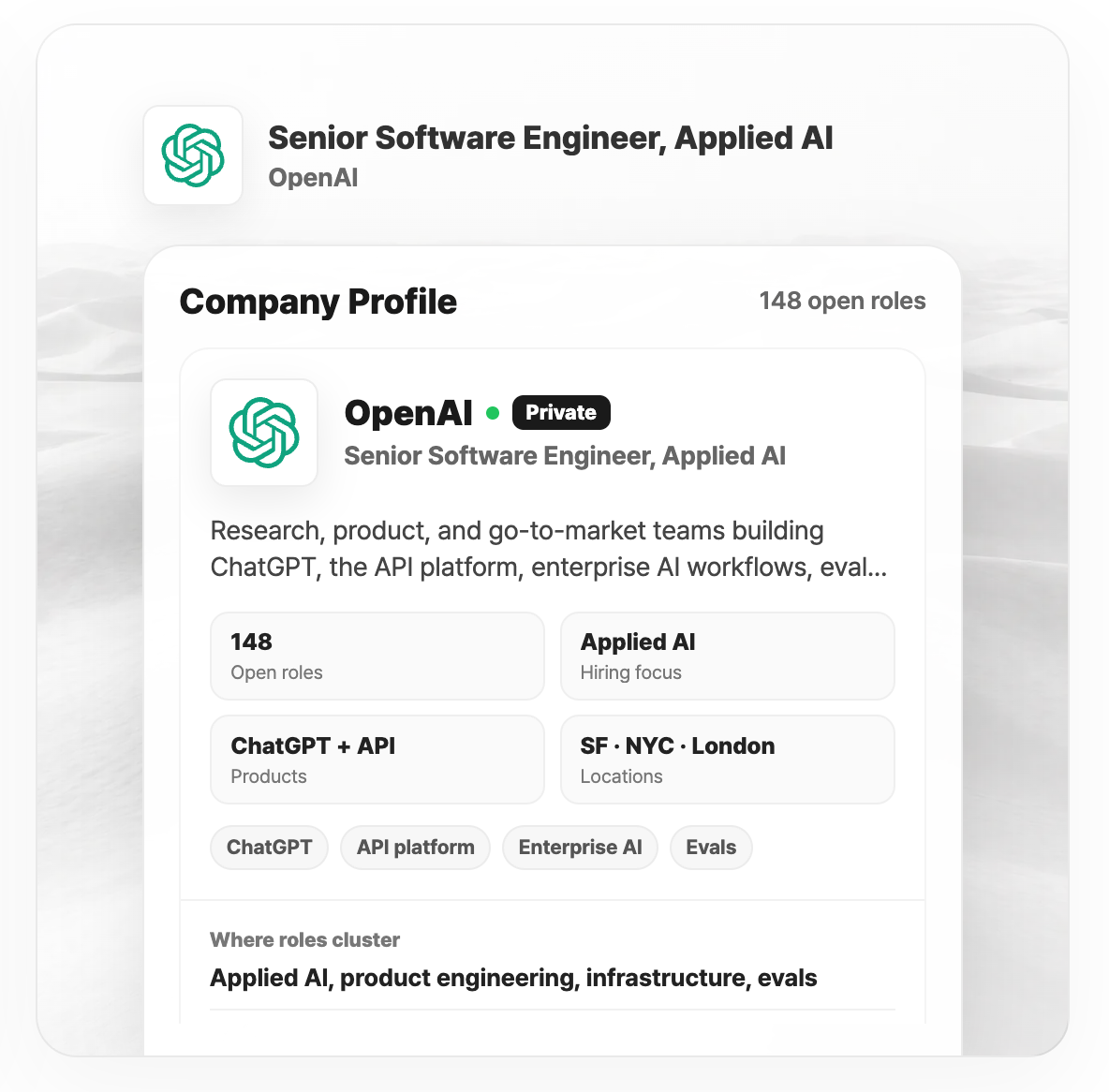
A company profile turns a job post from a list of requirements into a hiring context.
Reviews, compensation, interview signals, and similar roles should change the resume plan: what scope the resume needs to prove, which examples to prepare, and whether this opening is really the best target.
Before editing the resume, the candidate should be able to answer one practical question:
If I choose this role, what does my resume need to prove?
A job title does not answer that question.
Two roles can both be called "Senior Software Engineer, Applied AI" and still require different evidence. One team may need research infrastructure. Another may need API platform work. Another may care more about evals, product engineering, or customer-facing AI workflows.
If the candidate treats all of those roles the same, the resume becomes generic again.
3. The best starting points, already curated.
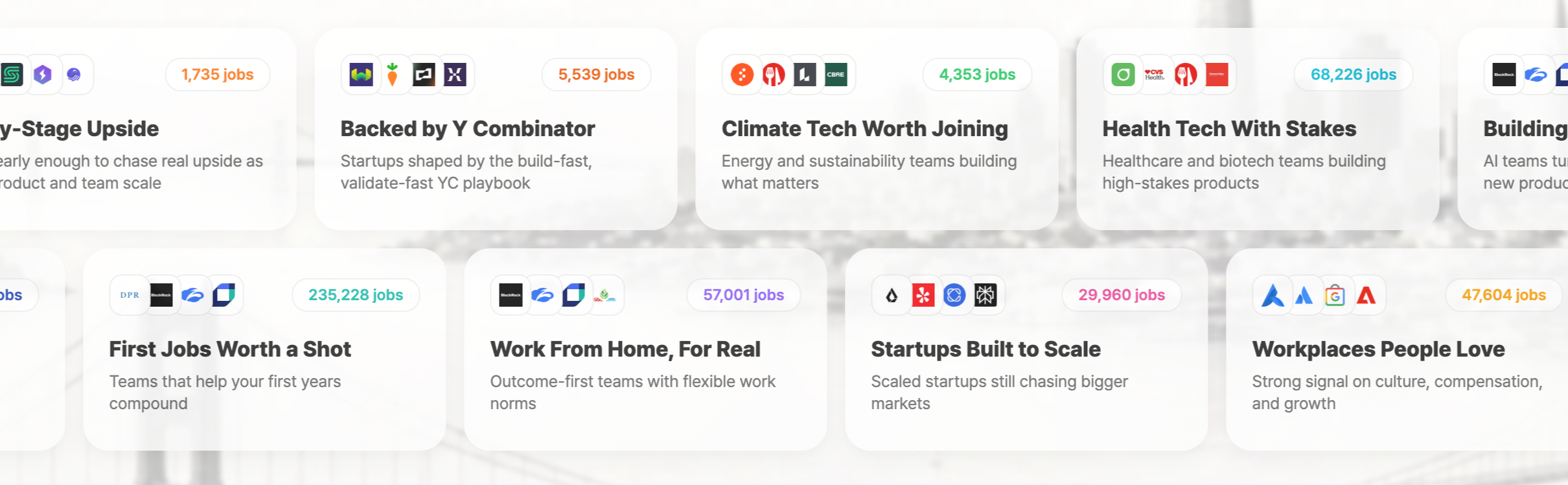
Curated collections are not just saved searches. They are starting points built around the way candidates actually choose where to spend time.
Some collections are based on the candidate's moment: internships, first jobs worth a shot, remote-first teams, visa-friendly roles, or companies that may be realistic for a global move. Others are based on the work itself: software engineering, product, design, data, operations, security, developer tools, climate, health tech, fintech, AI teams, early-stage upside, and Big Tech worth a shot.
The point is to avoid starting from a blank search box. A candidate can begin with a narrower, higher-signal set of roles, compare jobs inside the same context, and choose one target before editing the resume.
Jobs & Company Intelligence keeps the decision tighter:
-
Is this role worth tailoring for?
Use location, work setup, visa support, salary, reviews, company stage, and similar roles to decide whether the target is realistic. -
What proof should lead?
Use the role cluster and company context to decide whether the resume should lead with infrastructure, product judgment, customer-facing work, research depth, or operational ownership. -
What should I prepare or change before applying?
Use reviews, compensation, interview signals, and nearby roles to prepare stronger examples or choose a better-matched opening.
The difference is easier to see across roles:
- Applied AI engineer at an API platform company: a resume that opens with LLM experiments may miss the point. If the company signals enterprise workflows, evaluation systems, and platform work, the resume should lead with production APIs, reliability, customer deployments, eval pipelines, and incident handling.
- Product designer on a fintech checkout team: a portfolio full of polished screens is not enough. If the role is tied to conversion, payment failure, fraud friction, and merchant onboarding, the resume should lead with funnel decisions, research tradeoffs, measurable UX changes, and work with product and risk teams.
- Growth marketer for a global B2B product: campaign volume is not the strongest proof. If the company is expanding across regions, the resume should lead with market segmentation, lifecycle experiments, localization, pipeline influence, and channel efficiency.
- Operations manager at a marketplace company: generic process improvement is too vague. If the role depends on reliability and unit economics, the resume should lead with SLA design, vendor quality, escalation paths, queue time, cost-to-serve, and cross-functional rollout.
The same resume strategy cannot serve all of these roles. The target decides which proof belongs at the top. That is why Jobs & Company Intelligence comes before Mock Apply.
First, the candidate chooses a role worth targeting. Then they shape the resume around that target. Then Mock Apply tests the actual application materials before the real submission.
The biggest gap appeared after candidates applied
Even with a better resume and better job context, one gap remained.
After candidates submit an application, they usually learn almost nothing.
A typical rejection email looks like this:
The email is polite, but it gives almost no usable signal. Was the resume weak? Was the role wrong? Was the strongest proof buried? The answer is invisible.
That blind loop pushes candidates to apply more, make more resume versions, and wait again.
Mock Apply was built to break that loop before the real submission.
Mock Apply is a report before the real application
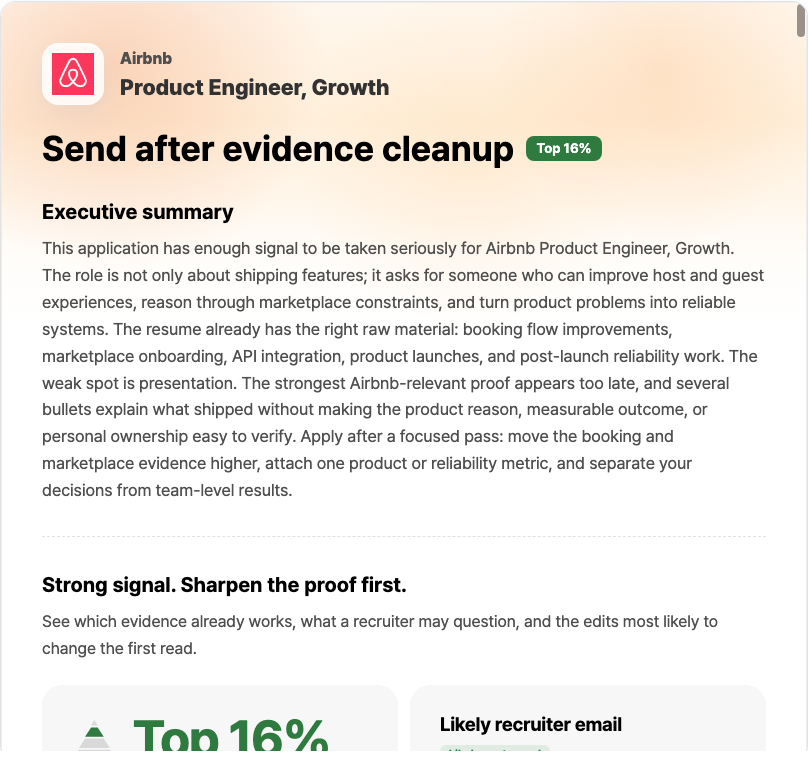
Mock Apply is a pre-application report.
It starts from the materials a candidate is actually about to send: one job, one resume, and short answers to role-specific questions.
refresh.cv reads those together and asks a sharper question:
If this application were reviewed today, where would it pass, stall, or need one focused fix?
A score can name risk, but candidates need something they can edit. Move a buried project up. Add the missing metric. Rewrite a risky claim. Close a keyword gap. Prepare the interview story that the resume will create.
The flow is intentionally short:
-
Choose the real job and resume.
Mock Apply reads the company, role, responsibilities, requirements, seniority hints, keywords, location, work setup, and available company or compensation context. If the job is not already in refresh.cv, candidates can paste the posting link and bring it into the workflow before running Mock Apply. -
Answer the recruiter basics.
refresh.cv asks for missing context such as work authorization, compensation range, role fit, evidence gaps, and details that do not fit naturally in the resume. -
Review the pre-send report.
The report explains how the application may read, what proof is weak, what may come up in interviews, and what to fix first.
When the report is generated, refresh.cv does not look at the resume alone.
It pulls together:
- The selected job posting: company, role, responsibilities, requirements, seniority hints, keywords, location, work setup, and available compensation or company context.
- The selected resume: projects, scope, metrics, ownership, tools, domain experience, ATS-readable structure, and the order of the strongest proof.
- Role-specific answers: work authorization, compensation range, fit context, missing proof, and details the resume leaves out.
- Company and hiring signals: company profile, reviews, interview signals, compensation context, similar roles, and nearby openings when available.
- Comparison signals: same-company and same-job Mock Apply users, similar-role candidates, similar-company candidates, and successful candidate patterns where refresh.cv has enough signal.
The value of the report is not its layout. It is that the application becomes something the candidate can actually change.
A useful report should answer practical questions:
- Should I apply now, revise first, or pause? Not as a vague score, but as a next move.
- How will this application be read first? What looks clear, what looks risky, and what still needs proof.
- What evidence is missing or buried? Unsupported claims, weak keywords, and strong projects that appear too late.
- What will I need to defend in interviews? Likely questions, weak stories, and examples worth preparing before a screen or onsite.
- What should I fix first? The few edits with the highest chance of improving this application before it goes out.
- Is this even the right target? When there is enough signal, a nearby role may fit the current resume better than the first posting.
This is why Mock Apply can be more specific than a generic resume review. It is checking the application against this company, this posting, and comparable candidate patterns.
The same issue appears inside the report:
- Product analyst: SQL is not enough if the role is really about experimentation. Mock Apply should notice when cohort analysis, funnel work, and A/B test decisions are buried below generic reporting automation.
- Backend platform engineer: "Built internal tools" is too soft for a reliability role. The report should push forward latency, incident response, on-call ownership, deployment safety, and system boundaries.
- Product designer: polished case studies are not the same as product judgment. For an onboarding conversion role, the report should ask what research changed, which metric moved, and what tradeoff the designer made with product and engineering.
- Solutions engineer: support stories are not enough for an enterprise pre-sales role. The report should surface integration depth, stakeholder mapping, security review, proof-of-concept outcomes, and handoff quality.
That is the useful difference: not one generic resume review, but a role-specific read of what each application needs to prove.
The important shift is that Mock Apply does not ask, “Is this resume good?”
It asks, “If this resume, this job, and these answers were read together, where would the application get stronger or weaker?”
The default should change
Most job-search advice still treats applications as progress.
Find a posting. Send a resume. Add one more application to the count.
That default is broken: it rewards motion, not judgment.
The old loop is simple: find a job, send a resume, wait.
The default we want is sharper:
- Decide whether the role deserves your time.
- Make the resume argue for that role, not a generic version of you.
- Run Mock Apply before the real submission.
- Fix the one gap most likely to weaken the application.
We are not trying to help candidates send more resumes into silence.
The goal is to help them pause, choose a better target, and understand the application before sending it.
Before a candidate sends an application, they should know what it is trying to prove.
FAQ: Mock Apply and refresh.cv
What is Mock Apply?
Mock Apply is a pre-application report in refresh.cv. It reads one selected job posting, one selected resume, and your role-specific answers together. The report also reflects same-company and same-job Mock Apply users, similar-role candidates, similar-company candidates, and successful candidate patterns where enough signal exists. It then shows role fit, screening outlook, score reasons, missing proof, risky claims, likely interview questions, and the highest-impact fixes before you submit.
Is Mock Apply the same as an ATS resume checker?
No. An ATS checker usually focuses on parsing, formatting, and keyword coverage. Mock Apply looks at the broader application: role fit, evidence quality, answer strength, interview risks, and the biggest fix to make before applying.
Why does refresh.cv include Jobs if it is also a resume product?
A resume only becomes meaningful against a target role. refresh.cv Jobs helps candidates search, filter, sort, compare, and choose roles worth tailoring for before they spend time rewriting the resume.
What does Agentic Resume Builder do?
Agentic Resume Builder helps candidates turn raw experience into stronger resume evidence. It can tailor a resume to a job posting, turn activity notes or portfolio files into bullets, adapt the resume for another hiring market, and provide target-role feedback before Mock Apply.
Who is this workflow best for?
It is useful for job seekers who do not want to send generic applications. It is especially helpful when you are applying to competitive roles, switching fields, targeting global companies, or trying to understand why a resume that looks clean may still not be ready for a specific job.
A small experiment to try today
Mock Apply does not need to start with a huge career plan.
Start with one real role.
- Choose a job you actually want.
- Import your current resume into refresh.cv.
- Tailor the evidence to that role.
- Run Mock Apply.
- Fix the single biggest weakness in the report.
That changes the feeling before the apply button.
Instead of “I hope this works,” the candidate can say, “I know what is strong, I know what is weak, and I know why I am sending this.”
That is the change refresh.cv is trying to make.
Before you apply, understand how your application may be read.
0
Get new posts by email
Subscribe to get new articles on resumes, interviews, career moves, and career growth.

Comments
yo
Jun 7, 2026
Great post
Jun 6, 2026