Forward Deployed Engineer Resume Guide: How to Write for AI and Customer-Facing Engineering Roles

A Forward Deployed Engineer is an engineer who works close to customers when the problem is still messy and the product path is not fully obvious.
In practice, a Forward Deployed Engineer role often combines customer discovery, technical scoping, hands-on software engineering, system integration, production rollout, and product feedback. In AI companies, that can mean turning a customer's workflow into an agent prototype, connecting it to real data and internal tools, testing it with users, and bringing the repeated patterns back into the product.
That is why a Forward Deployed Engineer resume needs a different kind of proof.
A standard software engineering resume says what you built. A strong Forward Deployed Engineer resume shows which customer problem you understood, what you built, where it was deployed, and what changed after it entered the real workflow.
This distinction matters because Forward Deployed Engineer roles are not just “software engineering plus customer calls.” They sit at the intersection of customer problem discovery, software engineering, integration, production deployment, and product feedback.
The hiring question is simple: can this person turn an ambiguous customer problem into a working system?
The job title sounds familiar, but the resume bar is different. A standard software engineering resume says what you built. A strong Forward Deployed Engineer resume shows which customer problem you understood, what you built, where it was deployed, and what changed after it entered the real workflow.
That distinction matters because Forward Deployed Engineer roles are not just “software engineering plus customer calls.” They sit at the intersection of customer problem discovery, software engineering, integration, production deployment, and product feedback.
The hiring question is not “Can this person code?” It is “Can this person turn a messy customer problem into working software that survives the real environment?”
This guide explains how to write a stronger Forward Deployed Engineer resume for Forward Deployed Engineer, Forward Deployed Software Engineer, Forward Deployed Developer, Applied AI Engineer, and customer-facing engineering roles.
Why Forward Deployed Engineer roles are growing in AI
AI products often fail between the demo and the deployment. The model may be powerful, but the customer still has messy data, legacy systems, approval flows, security constraints, and people who need the product to fit their existing work.
That is why AI companies are hiring more engineers who can work close to customers without stopping at advisory work.
OpenAI's Forward Deployed Engineer role explicitly emphasizes customer-facing technical deployment, direct coding when it helps progress, turning field patterns into reusable tools or playbooks, and sending product feedback back from the field. OpenAI's Forward Deployed Software Engineer role frames the work around building custom software with OpenAI APIs to solve real customer problems.
Palantir's Forward Deployed Software Engineer article shows the older version of this playbook: engineers embedded close to customer operations, building data integration and decision workflows in the field. Anthropic's Forward Deployed Engineer, Applied AI description uses similar language around embedding with strategic customers and shipping AI applications that solve real business problems. Snowflake's Forward Deployed Engineer, Applied AI role points to the same market direction: AI, data platforms, customer systems, and production outcomes are being pulled closer together.
So the resume needs to prove more than technical depth. It needs to prove deployment judgment.
What a Forward Deployed Engineer resume has to prove
A normal engineering resume can be strong and still be weak for a Forward Deployed Engineer role.
Why? Because many engineering resumes describe internal systems in isolation. They say what the candidate built, but not why the customer needed it, how it entered the customer's workflow, or what constraints made the work hard.
An Forward Deployed Engineer resume has to show four layers at once:
| Layer | What the reader is checking |
|---|---|
| Customer problem | Did you understand the real workflow, not just the requested feature? |
| Technical build | Did you personally design, code, integrate, or deploy something meaningful? |
| Field constraints | Did you handle messy data, permissions, security, legacy systems, or stakeholder pressure? |
| Product learning | Did the field work create reusable patterns, product feedback, or repeatable deployment motion? |
If one of those layers is missing, the resume starts to drift.
If it only shows code, it reads like a generic SWE resume. If it only shows customer interaction, it reads like solutions consulting. If it only shows strategy, it reads like a slide deck.
A strong Forward Deployed Engineer resume connects the customer problem to the system that shipped.
Start with a clean resume template, then make it role-specific
Before the Forward Deployed Engineer-specific work, the resume still needs a clean structure. If the layout is hard to scan, the strongest evidence may never get read.
You can start with a free resume or CV template in refresh.cv, then tailor the content for the actual Forward Deployed Engineer job posting. The separate guide, Free Resume & CV Templates You Can Tailor to a Job Posting, explains the template flow in more detail.
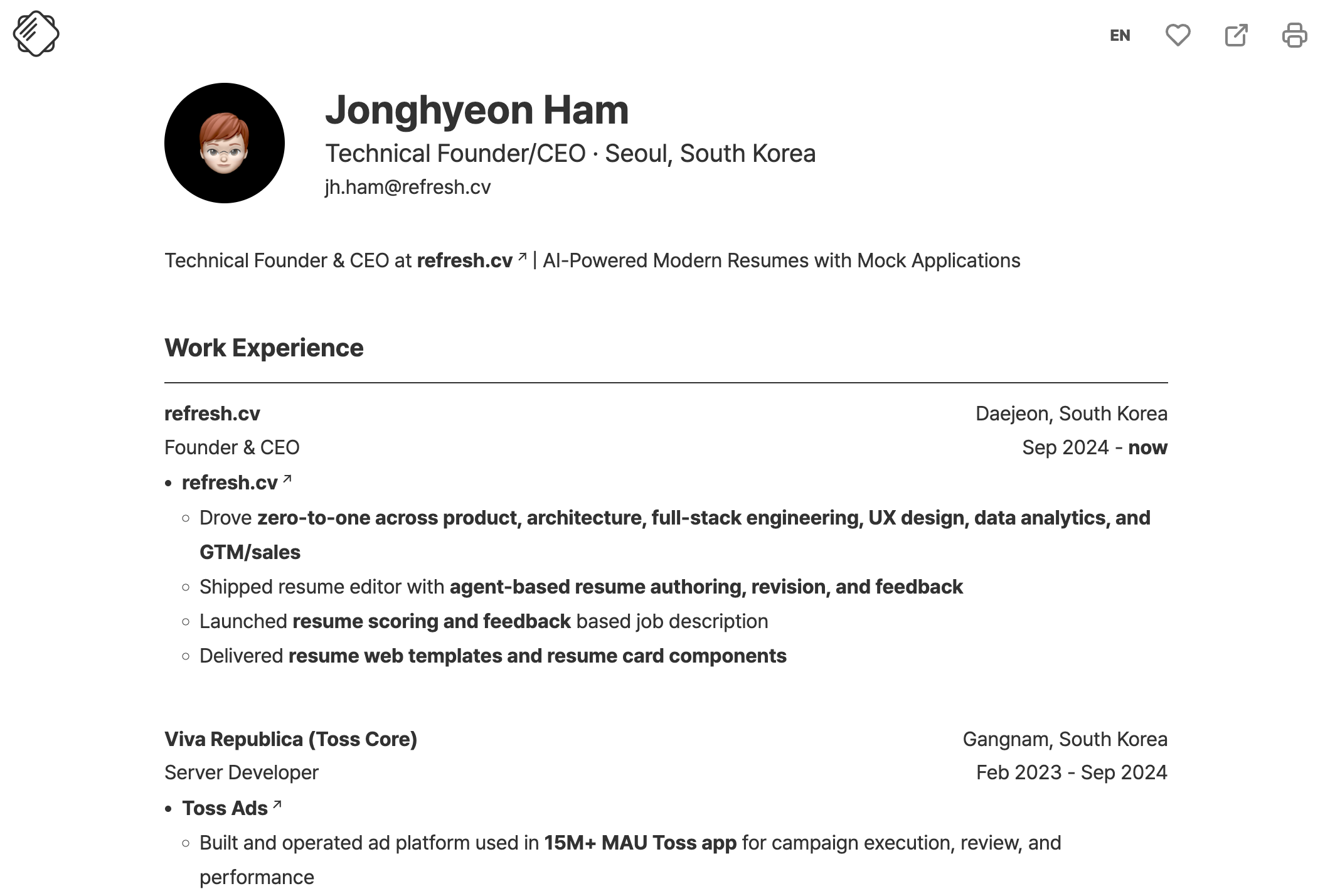
But the template is only the starting point. For Forward Deployed Engineer roles, the content needs to move from “projects and tools” to “customer problem, shipped workflow, integration, and proof.”
The 6 resume signals Forward Deployed Engineer hiring teams look for
1. Customer problem discovery
Forward Deployed Engineer work usually begins before the problem is perfectly defined. A customer may ask for a dashboard, AI assistant, automation, or integration. The real problem may be buried in handoffs, data quality, decision latency, compliance steps, or operating cost.
Show that you can find the real problem.
Weak:
Gathered customer requirements for an internal dashboard.
Stronger:
Reconstructed a manufacturing quality-review workflow from operator interviews, machine logs, and escalation notes, then redesigned the alert path so plant engineers could review high-risk equipment before the daily inspection cycle.
Why it works: it shows the customer environment, the discovery method, the operational workflow, and the decision point.
2. Fast building that reaches the workflow
A prototype is not enough. FDEs are valued because they can move from ambiguity to a working system that real users can try.
Show the distance between idea and use.
Weak:
Led a customer PoC.
Stronger:
Built a logistics exception-management dashboard that combined order status, delay reasons, and owner actions into one queue, then connected the pilot to the daily manager review so the team could prioritize risk before shipment cutoffs.
This is more useful because it shows what was built, who used it, and how it entered the workflow.
3. Integration with real customer systems
Forward Deployed Engineer work does not happen in a blank repo. It touches CRM records, support tickets, ERP data, warehouse tables, Slack workflows, permissions, SSO, audit logs, and internal APIs.
If your resume says “integrated APIs,” it is probably underselling the work.
Better:
Integrated CRM records, support tickets, and contract metadata into a renewal-risk tool, then added SSO and role-based access so sales, customer success, and leadership could each view the account context they were allowed to use.
That line gives the reader enterprise context. It says you can build inside the customer's environment, not just beside it.
4. Production constraints and tradeoffs
The Forward Deployed Engineer version of engineering judgment is not just architecture elegance. It is knowing what to build first when security review, data access, customer urgency, and legacy systems all limit the ideal solution.
Good Forward Deployed Engineer bullets often mention constraints:
- Data access was incomplete, so the first version used a narrower signal.
- Security review blocked one integration, so the team shipped a lower-risk workflow first.
- Customer users were overloaded, so the interface had to fit an existing review meeting.
- The proof of concept had to become reusable, so custom logic was extracted into a template.
A stronger resume does not hide constraints. It shows how the candidate made decisions inside them.
5. Field feedback that becomes product leverage
This is where Forward Deployed Engineer work becomes more than services.
OpenAI's Forward Deployed Engineer posting mentions codifying working patterns into reusable tools, playbooks, or building blocks. That is a useful clue for resume writing too: if you helped turn one customer implementation into a repeatable product pattern, make that visible.
Weak:
Supported three enterprise deployments.
Stronger:
Identified repeated approval and permission patterns across three onboarding automation pilots, then converted customer-specific scripts into reusable workflow templates for future deployments.
This shows field learning, not just field activity.
6. Interview-ready ownership
Forward Deployed Engineer interviews often press on ownership. Did you personally code? Did you scope the work? Did you lead customer discovery? Did you make the tradeoff? Did you debug the deployment?
Your resume should make your ownership easy to defend.
Replace vague verbs like “supported,” “contributed,” and “worked on” with clearer verbs when they are true: designed, built, integrated, deployed, scoped, debugged, rewrote, automated, instrumented, migrated, evaluated, or standardized.
Forward Deployed Engineer resume examples by background
Different candidates should lead with different proof.
Backend engineer applying to Forward Deployed Engineer
Do not only list APIs, queues, services, and databases. Tie them to customer workflow.
Before:
Built backend APIs for transaction monitoring.
After:
Designed transaction-status APIs and a retry queue for a payments customer so operations teams could identify settlement delays before manual reconciliation began.
Product engineer applying to Forward Deployed Engineer
Do not only show UI shipping speed. Show that the UI handled real workflow complexity.
Before:
Built an admin dashboard for customer operations.
After:
Built an exception-review dashboard that matched the customer's daily operations meeting, grouped unresolved cases by owner and severity, and reduced context switching between support tickets, order data, and Slack updates.
Data or AI engineer applying to Forward Deployed Engineer
Do not only name models, embeddings, agents, or LLM frameworks. Show the business workflow the model changed.
Before:
Built an LLM chatbot for support automation.
After:
Designed a support triage workflow that classified repetitive questions, drafted agent responses, routed low-confidence cases to human review, and logged failure cases for weekly prompt and retrieval evaluation.
Solutions engineer or consultant applying to Forward Deployed Engineer
Do not only show discovery and presentations. Prove technical ownership.
Before:
Worked with enterprise customers on AI adoption strategy.
After:
Converted a customer's manual compliance-review process into a working AI-assisted review flow by mapping decision criteria, building the first document-classification prototype, and handing engineering a tested integration plan.
How refresh.cv helps turn Forward Deployed Engineer experience into resume evidence
Forward Deployed Engineer candidates often have the right experience, but the resume hides it. The bullets talk about projects, tools, or customers, but the proof is buried.
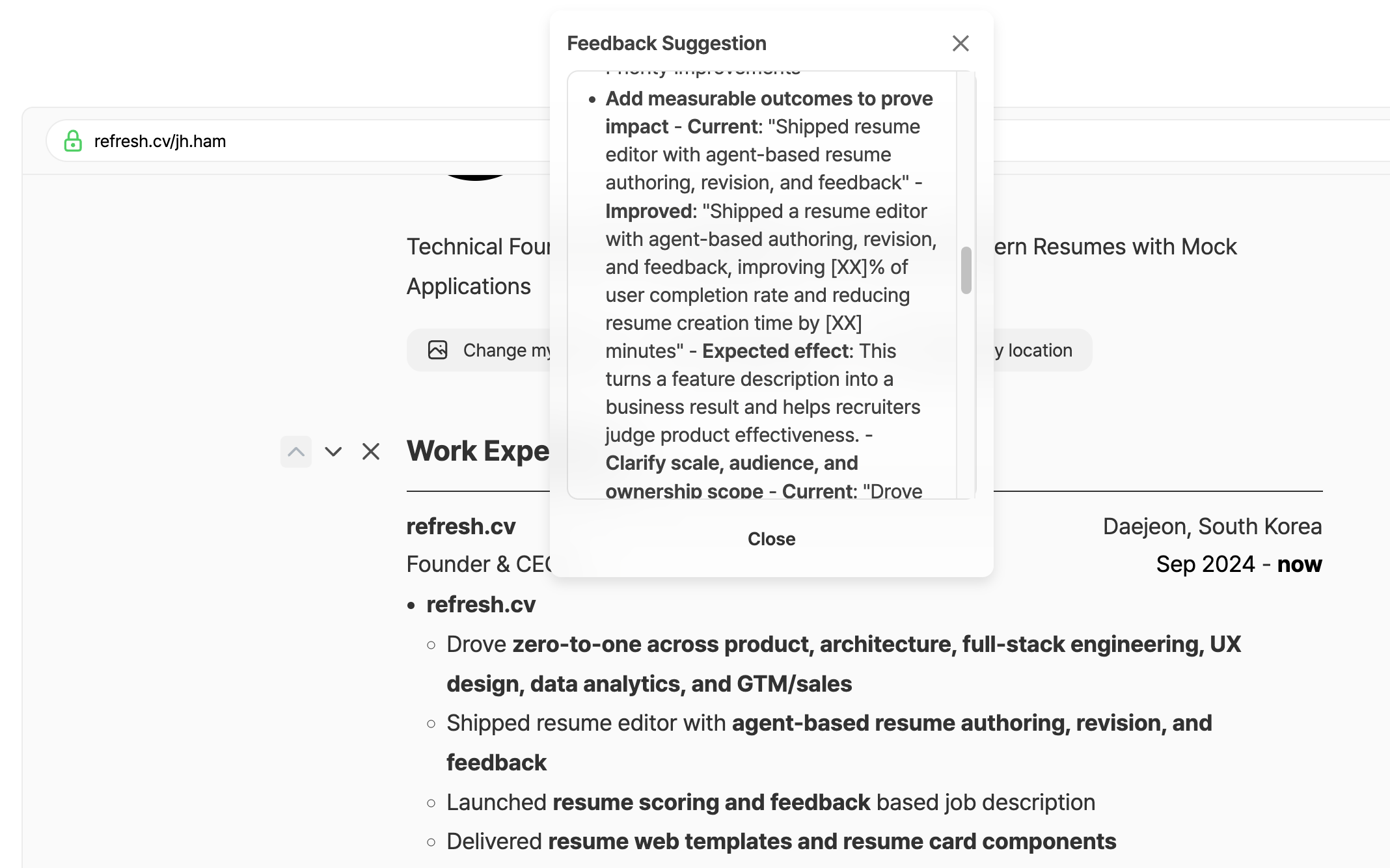
Agentic Resume Builder is useful here because the work is not just rewriting. It keeps asking for the missing evidence: scale, workflow, user, constraint, system, tradeoff, and outcome.
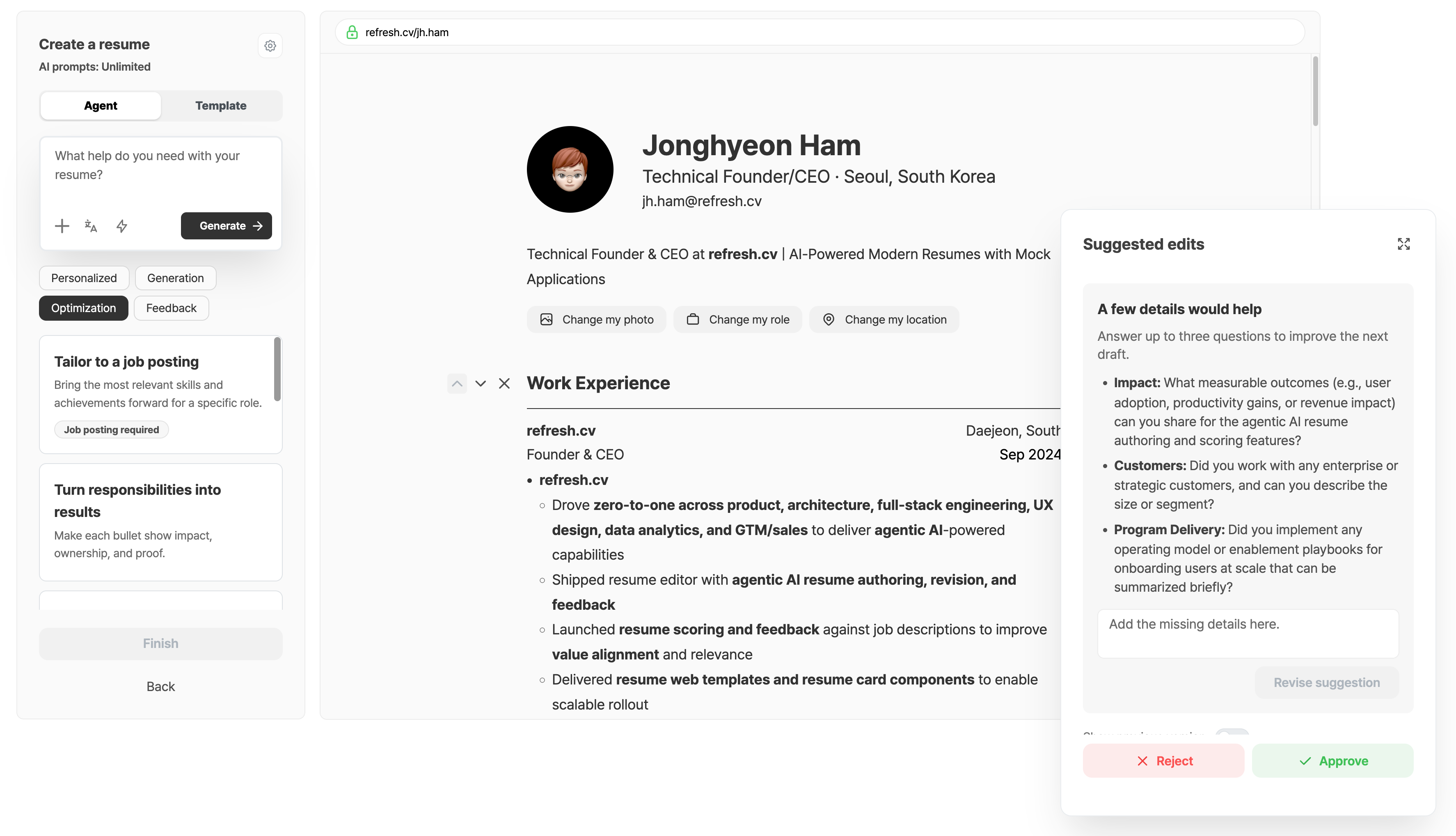
For Forward Deployed Engineer roles, this matters because vague bullets need follow-up questions.
- What was the original customer problem?
- Who used the workflow?
- Which systems did you connect?
- What was the production constraint?
- What changed after deployment?
- Which part became reusable?
- What number should be verified instead of invented?
refresh.cv does not need to invent a more impressive career. It should help the candidate surface the proof that already exists.
A simple Forward Deployed Engineer resume checklist
Before you apply, check whether the resume answers these questions:
- Does the top half of the resume show customer-facing engineering, not only internal engineering?
- Can a reader see the customer problem behind the work?
- Does each strong bullet include a workflow, system, constraint, or outcome?
- Are integrations specific enough: data source, API, permission model, business system, or deployment path?
- Are metrics honest, with placeholders where the real number still needs confirmation?
- Does the resume show field learning that could become product learning?
- Can you defend exactly what you personally owned in an interview?
- Is the resume tailored to this Forward Deployed Engineer posting, not just a generic AI engineering role?
The last question is important. OpenAI, Palantir, Anthropic, and Snowflake may all use Forward Deployed Engineer-like language, but the evidence they reward can differ. One role may care most about custom software on top of AI APIs. Another may care about data integration. Another may care about high-stakes enterprise deployment.
How to tailor the resume to one Forward Deployed Engineer job posting
A practical workflow looks like this:
- Start with a clean resume template.
- Pick the actual Forward Deployed Engineer job posting.
- Rewrite the top experience bullets around the role's strongest signals.
- Move customer-facing engineering evidence into the first half of the resume.
- Add missing context: user, workflow, integration, constraint, and outcome.
- Keep unverified numbers as placeholders until you can confirm them.
- Run a final review against the posting before applying.
That is the difference between an engineering resume that happens to mention customers and a Forward Deployed Engineer resume that is built for the role.
Final thought
A weak Forward Deployed Engineer resume says:
I can code and I can talk to customers.
A stronger Forward Deployed Engineer resume says:
I can understand a customer's operational problem, build the software, ship it into the real environment, and turn what I learned into a repeatable product advantage.
That is the story your resume needs to make easy to believe.
Want to tailor your resume for a Forward Deployed Engineer role?
Start with a free resume template in refresh.cv, choose a real Forward Deployed Engineer job posting, and rewrite your experience around the customer problems you actually shipped.
Sources and references
0
Get new posts by email
Subscribe to get new articles on resumes, interviews, career moves, and career growth.