UX Resume vs. Portfolio: What Goes Where?
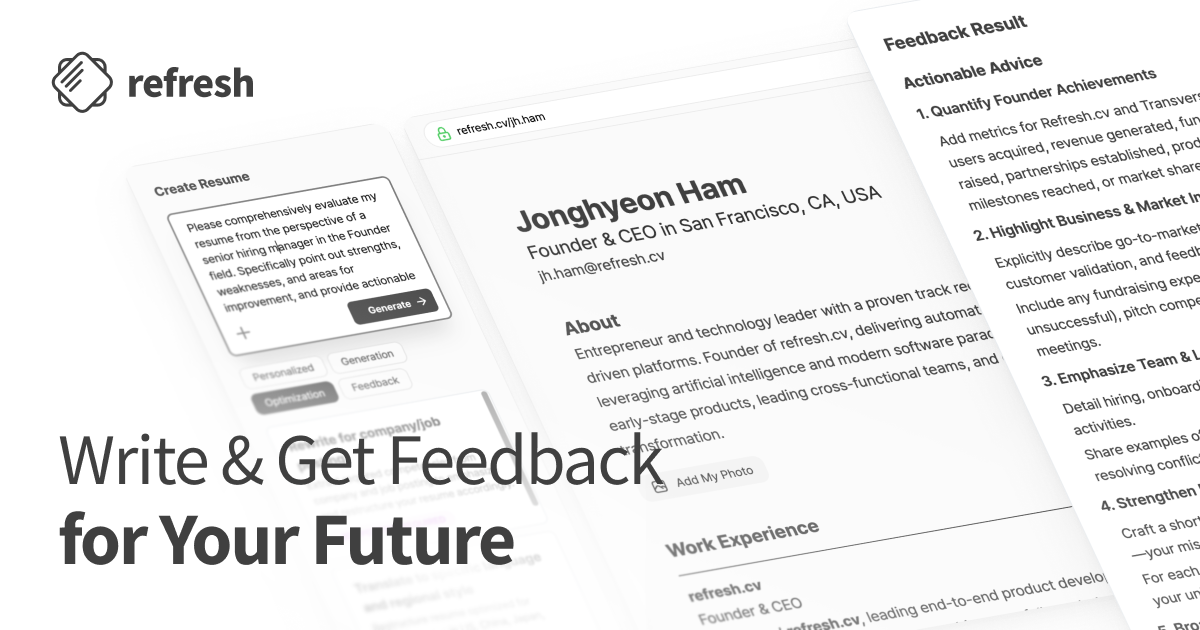
Deciding what belongs in your UX resume and what belongs in your portfolio? At refresh.cv, we start with the job description: extract its requirements and ATS keywords, compare them with your resume wording and actual experience, then prioritize truthful revisions.
Quick answer: Put relevant responsibilities, scope, and results in your resume. Use your portfolio to show the problem, design decisions, work, and evidence behind those claims.
You can use the same project in both documents. Your resume answers what you were responsible for. Your portfolio explains why you chose an approach and what you used to evaluate it. Let the job description guide what you include in each.
Start with the job's deliverables, collaboration, and problem-solving requirements
Read the target job description and map its requirements to your experience. The table below is a writing framework, not a claim that every UX role requires the same skills. Include only the requirements relevant to that posting.
| Requirement in the job description | Summarize in your resume | Expand in your portfolio |
|---|---|---|
| Deliverables such as user flows, wireframes, or prototypes | The design scope you personally owned and the work you completed | Actual deliverables, before-and-after flows, and the reasoning behind the design |
| Collaboration with product and engineering | Who you worked with and what you coordinated | Points of disagreement, implementation constraints, alternatives, and agreed decisions |
| Problem-solving through user research or usability evaluation | The activities you performed and the results you confirmed | Observation records, how you interpreted the problem, and evidence behind revisions and evaluation |
Do not copy tool names into your resume without explaining what you made with them. If a posting asks for user research and you have not conducted it, do not add it to your experience. If you have relevant experience but your resume lacks the posting's terminology, add wording that accurately describes the work.
Keep resume descriptions focused on role, scope, and results
List the project name and dates, then describe the problem + your action and scope + the confirmed result.
If you worked on a service redesign but owned only the sign-up screens, do not imply that you led the entire redesign. Separate your contribution from the team's results.
Before using a metric, check what was measured and over what period. If you do not have a number, do not invent one. Describe a completed design change or a confirmed evaluation finding instead.
A finished prototype, a launched feature, and a measured post-launch effect are different outcomes. If your work stopped at the prototype stage, describe that completed prototype rather than claiming a launch or an improvement in user behavior.
Point readers to the relevant portfolio case study by title or location. The goal is to connect each resume claim to supporting work, not to move every research note and screen explanation into your resume.
Use your portfolio to explain decisions and show the work
In Nielsen Norman Group's UX design portfolio guide, Rachel Krause recommends choosing projects relevant to the work you want to do. Case studies should explain the problem, your role and collaboration, the process that led to the solution, the results, and alternatives you did not pursue. Focus on explaining decisions rather than displaying final screens alone.
Organize each case study around these questions:
- Problem and context: Whose difficulty were you addressing, and what constraints shaped the work?
- Your role: What did you do personally, and what did teammates do?
- Research and findings: What records helped you identify the problem or form a hypothesis?
- Alternatives and decisions: What did you compare, and why did you choose that approach?
- Results and remaining work: What changed, and what did you actually confirm?
Place an explanation beside each artifact that identifies the decision it supports. For a wireframe, explain why you changed the information order.
Do not force every project into the same process. Show the work you actually performed. Do not add interviews or tests that did not happen.
Example: Split a sign-up project between your resume and portfolio
The following is a hypothetical sign-up flow project, not a real candidate's experience. Replace it with your own work and confirmed results before using it in an application.
Assume the designer reviewed existing usability test records and compared alternatives for the placement and display of error messages. They coordinated implementation scope with a developer and completed a revised prototype. The design has not launched, and no follow-up evaluation has taken place.
Resume: Replace a vague collaboration claim with specific work
Before: “Collaborated with the development team.”
After: “Redesigned error states and messages in the sign-up flow using existing usability test records; coordinated implementation scope with a developer and completed a revised prototype.”
The revised sentence names the context, the issue addressed, the designer's actions, the scope of collaboration, and the completed deliverable. It does not claim that the designer conducted the original tests.
In this example, the confirmed result is a completed prototype. You cannot add a higher sign-up completion rate or improved usability as an outcome, because neither was established.
Portfolio: Show what supports each resume claim
| Resume claim | Supporting portfolio content |
|---|---|
| Reviewed existing usability test records | Observations related to error messages and your interpretation of them. Do not present this as testing you personally conducted. |
| Redesigned error states and messages | Alternatives for message placement and display, the reasons for your choice, and before-and-after flows |
| Coordinated implementation scope with a developer | Constraints discussed, your proposals, and the scope you agreed on |
| Completed a revised prototype | The final artifact and its current status. State that it has not launched and follow-up evaluation remains outstanding. |
Instead of repeating the resume sentence at greater length, show the materials behind “reviewed,” “redesigned,” and “coordinated.” For collaboration, explain the decisions you contributed to rather than only noting that you attended meetings.
For entry-level applicants and career changers, label the work accurately
If the work was a class assignment or personal project, state that context and your scope of responsibility. For a team assignment, distinguish the research and design you performed from work completed by others. Label work that was not implemented as a proposal or prototype.
If you are changing careers, identify actions from your previous work that connect to the job description. For example, you can describe categorizing customer support inquiries and sharing an improvement proposal if that is what you did. Do not relabel it as conducting user interviews or leading UX research.
“Categorized support inquiries to develop a problem hypothesis” and “Confirmed the cause through user research” are different claims. Keep proposals separate from implemented changes, and hypotheses separate from validated findings. Attach evidence that matches the wording you use.
Before submitting, match the job requirements to both documents
For each key requirement in the posting, pair a resume statement with a supporting portfolio case study. Check that the role, dates, and results agree across both documents, and that a team result has not become an individual achievement.
Our revision framework follows the same principle:
- Keyword and experience evidence are both present: Retain the supported wording.
- Relevant experience is present, but the wording is missing: Add the appropriate term without overstating the work.
- Neither the keyword nor supporting experience is present: Do not add the keyword alone.
At refresh.cv, we distinguish resume quality feedback on specificity, achievements, wording, and grammar from job-specific keyword fit. Neither assessment guarantees a hiring outcome.
Submission checklist
- Job relevance: Each selected requirement connects to real experience.
- Ownership: Your responsibilities are distinct from the team's work.
- Evidence: Each resume claim points to supporting portfolio material.
- Outcome accuracy: Prototype completion, launch, and measured effects are labeled separately.
- Consistency: Roles, dates, and results match across both documents.
Compare your target UX job description with your current resume in refresh.cv. Revise the statements your experience supports, then check each one against the linked portfolio case study.
0
Get new posts by email
Subscribe to get new articles on resumes, interviews, career moves, and career growth.