Team Projects on Your Resume: Show Your Own Contribution
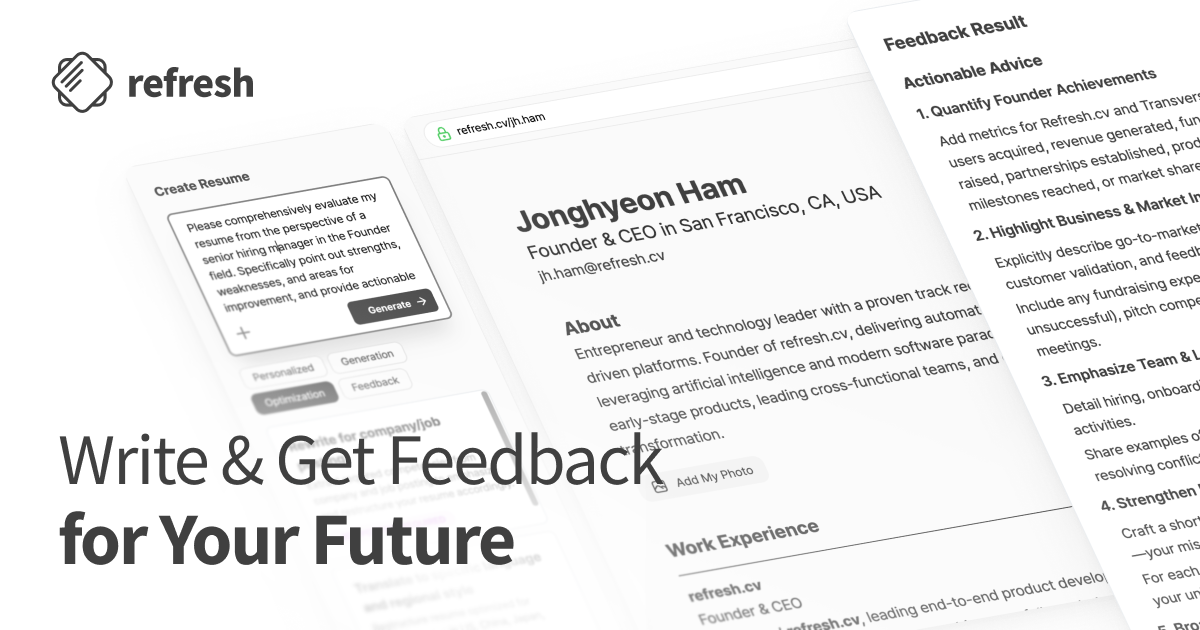
Writing about a team project on your resume? At refresh.cv, we start with your target job description, identify requirements and ATS keywords, and compare them with your resume wording and actual experience evidence. That comparison helps you prioritize truthful revisions while distinguishing your own work from the team's accomplishments.
Quick answer: Present the shared outcome as a team result, then describe your own actions and deliverables separately. Match the job description to work you actually performed, not responsibilities that belonged to teammates.
For team projects, check who actually did the work before adding a keyword. Use that same standard when you review your resume against a job description.
Match the job requirements to work you personally did
Review the skills a job description calls for and choose experiences that demonstrate those skills. Use that relevance check when deciding which team projects to include.
Start with your actions rather than the project's size. If a posting asks for customer requirements gathering, connect it to work you performed, such as categorizing customer inquiries or drafting a requirements document. If you only handled development on that project, do not claim a teammate's customer research as your own.
Before drafting a bullet, answer these questions:
- What did you work on directly?
- Which methods or tools did you actually use?
- Which part of a deliverable did you create?
If you have relevant experience but the wording is vague, describe it more precisely using the posting's terminology where accurate. If you do not have that experience, do not add it simply because someone on the team performed the task.
Separate the shared outcome from your individual role
The MIT AeroAstro Communication Lab resume and CV guide emphasizes your distinct role and specific actions. Explain not only what you did, but how you did it. For research experience, the guide allows a brief overview of the lab's work while stressing that your individual contribution must be clear. You can apply that distinction to team projects by separating the overall context from your own work.
Use this table as a drafting worksheet, not a required resume format.
| Item | What to record | What to check |
|---|---|---|
| Project goal | The problem the team set out to solve | What were you trying to build or improve? |
| Shared outcome | A team launch, delivery, or presentation | Was it actually completed? |
| Your responsibilities | Work and responsibilities you personally handled | What did you decide, and what did you support? |
| Your deliverables | Analysis tables, code, designs, or requirements documents | Which parts did you create yourself? |
| Supporting records | Work history, meeting notes, or results reports | What supports your description of the role and result? |
“The team launched the service” and “I led the launch” are different claims. Put the shared outcome in the project description and your contribution in the bullets beneath it. A verified team result does not establish that your work caused that result on its own.
If you cannot confirm the final outcome, you can still describe deliverables and work you can substantiate. Write “drafted requirements” rather than assuming the work led to a successful launch.
Replace vague role labels with specific actions
Do not automatically turn “participated in” into “led.” Apply the MIT AeroAstro Communication Lab's guidance on concrete actions without expanding your responsibility.
If your draft says “supported analysis,” identify what that meant. Did you collect materials, create categories, or review findings? A more specific description might be: “Categorized customer inquiries by type and documented recurring requests.” If you only collected the materials, do not rewrite that task as conducting the analysis.
If you use “led,” explain what you decided or coordinated. If you coordinated the schedule, say so. If the team selected features together, do not imply that you made those decisions alone.
For a jointly written document, distinguish the sections you drafted from the parts you reviewed or discussed. Being accurate about your role does not mean underselling it.
Before and after: a team launch and an individual deliverable
The following example is hypothetical. Adapt it only to responsibilities and records that match your own experience.
Assume a job posting asks for customer inquiry analysis and improvement requirements documentation. The project team launched a new service. The applicant categorized inquiries and drafted requirements. The team set feature priorities together, while other teammates handled development and deployment.
Before: the bullet blends team results with personal responsibility
Led a new service launch from customer analysis through development and improved customer satisfaction.
This exceeds the responsibilities in the example. The applicant did not develop the service, and no change in customer satisfaction has been established. Remove those claims before polishing the verbs.
After: separate project context from your contribution
Use the project description for the shared outcome:
Contributed to a team project that launched a new service.
Then describe the work you personally performed:
Categorized customer inquiries by type and documented recurring requests to draft improvement requirements. Shared the draft with the team and participated in feature-prioritization discussions.
The launch remains a team result. The individual contribution identifies the context, the recurring customer requests, the applicant's actions, the boundaries of the role, and the resulting draft.
To connect this work more precisely to “customer inquiry analysis,” explain which categorization criteria you actually applied and what you compared. Do not invent an analytical method you did not use.
If only your deliverables are confirmed, stop there
Now assume the inquiry categorization table and requirements draft are confirmed, but the launch is not. You could write:
Created a customer inquiry categorization table and a list of recurring requests, then used them to draft improvement requirements.
Whether the draft was implemented and whether inquiries later decreased are separate facts. Before adding metrics, verify what was counted, the measurement period, and the calculation. Label team-wide metrics as shared results, and avoid implying that your work alone caused the change.
Check that AI revisions preserve who did the work
In our pre-application review workflow, we compare the job description with your resume and distinguish these evidence states:
- Keyword and experience evidence are both present. Keep wording that accurately describes work you can substantiate.
- Relevant experience is present, but the exact keyword is missing. Clarify the wording where the posting's terminology fits your actual work.
- Both the keyword and your experience evidence are missing. Do not add the requirement as a skill or responsibility you have performed.
Apply those distinctions to each AI-suggested sentence. In the example, keep “drafted improvement requirements” if the resume includes it and the draft supports it. If you categorized inquiries but the wording does not clearly explain that experience, prioritize that revision.
Do not add development skills that belonged to another teammate. Do not turn participation in a launch into responsibility for leading it.
Resume quality checks and job-specific keyword fit are separate assessments. Neither represents your hiring probability or an employer's actual ATS evaluation.
Submission checklist
Before submitting, review each revised sentence:
- Team results: Is it clear which outcomes belong to the team?
- Personal responsibility: Have you distinguished work you performed from work you supported or discussed?
- Tools: Did you actually use every tool listed?
- Evidence: Can you substantiate the deliverables and metrics?
- Causality: Have you avoided claiming an unverified link between your actions and a result?
Enter your target job description in refresh.cv and compare it with your project bullets. Start with experience you can substantiate but have not described clearly. Accept only revisions that match your actual responsibilities. Keep the shared result, and make your contribution within it explicit.
0
Get new posts by email
Subscribe to get new articles on resumes, interviews, career moves, and career growth.