Resume Section Order: Education or Work Experience First?

The default resume order is contact info, work experience, education, then skills, and each section sorts newest first. Move education above experience only when it is currently your strongest proof for the job, which usually means you are a student, a recent grad, or applying for a role with a hard credential requirement. We build refresh.cv around exactly this comparison between a job posting's requirements and the evidence already sitting in your resume, so section order is a question we deal with daily.
Staring at a blank resume, the point where most people stall is order. Which sections to build, what goes inside them, and whether education belongs at the top all get decided at once. Order decides where a reader's limited attention goes first. MIT's Career Advising and Professional Development office (CAPD) tells students that recruiters typically spend six to ten seconds on a first pass of a resume. Whatever sits in that window is the only part of the page that reliably gets read, and that is the whole logic behind ordering sections.
Resume, Career Narrative, and Cover Letter Are Different Jobs
Treating a resume, a longer career narrative, and a cover letter as one blended document is what makes resumes bloat and lose focus. Splitting the three roles first makes it obvious which sentence belongs where.
| Document | Job | What Goes In | Sentence Style |
|---|---|---|---|
| Resume | A list of verifiable facts | Contact info, work history, education, skills, certifications | Short lines and bullets |
| Career narrative / portfolio notes | Proof of what you did and built | Project-level role, actions, results | Sentences carrying numbers |
| Cover letter | Interpretation and motivation | Why this role, what you learned, fit | Contextual prose |
Korea's national employment platform Work24 advises candidates to list the company name, business area, department, final title, employment dates, main duties, and quantified results in the work history section. The same guide recommends matching the terminology used in the job posting itself when you describe your duties. Keep the resume compressed to those facts and push anything that needs room to breathe into a longer document instead. That single split solves most length problems before you write a word about experience.
Education or Experience: Which Goes on Top?
There is one test here. Whichever section proves the posting's requirements more directly goes first. Years on the job are not the deciding factor; strength of evidence for this specific posting is.
| Situation | Recommended Order | Why |
|---|---|---|
| Current student, recent grad, or within a year of graduating | Contact info → Education → Experience (internships, projects) → Skills | Coursework, class projects, and research are your most verifiable proof right now |
| One or more years of relevant work experience | Contact info → Experience → Education → Skills | On-the-job results map more directly to the posting's requirements than a degree does |
| Career change | Contact info → Related experience → Other experience → Education | Keeps unrelated work history from occupying the top of the page |
| Roles with a hard degree or license requirement | Contact info → Education/Credentials → Experience | The requirement has to be confirmed before anything else gets read |
The career-change row is the one people underuse. MIT CAPD recommends grouping your most relevant experience into an early, prominent category and moving lower-relevance work into a separate "additional experience" section further down the page. That means pulling out the two or three projects from a job that actually match the posting, rather than dragging the entire role up wholesale.
Whatever order you choose between sections, keep entries inside each section sorted newest first. Harvard's Mignone Center for Career Success (part of Harvard FAS) tells students to list items within each category in reverse-chronological order and avoid leaving unexplained gaps, even a single missed summer.
What Belongs Inside Each Section
Contact info. Name, a phone number and email you actually check, and a portfolio or profile link if one is relevant. MIT CAPD advises leaving out age, religion, health information, and marital status, skipping a photo since US resumes generally do not include one, and never naming a reference before being asked. Harvard FAS notes that resume conventions vary by country, so if you are applying somewhere with a company-specific template that asks for a photo or date of birth, follow that template instead.
Work experience. Company, department, title, and dates in month-year format, with duties and results as bullets underneath. If you changed departments or were promoted, call it out explicitly the way Work24's guide recommends, so a reader can see internal movement inside one company rather than assuming three short stints.
Education. School, major, and graduation date, newest first. If a class project or research directly supports the posting, one or two lines under the degree line reads more naturally than a separate section built just for it.
Skills. Group tools, languages, and methodologies by category. MIT CAPD points out that employers may run keyword scans on a resume, so the terms your industry actually uses need to show up in the document itself, not just be implied. Any tool listed under skills should also appear at least once inside a work or project bullet; a skill with no evidence behind it reads as unverified.
If your experience section feels thin, the scope you are using is probably too narrow. The University of Wisconsin-Madison's Office of Student Success advises building the experience section from more than paid work alone, including class projects, volunteering, and leadership roles.
Turning a Duty Into a Result
The most common weak sentence just restates a job duty. Fixing it means adding three things: what you did, how, and what changed because of it.
| Duty-Focused | Result-Focused |
|---|---|
| Handled customer inquiries | Sorted inquiries into 12 categories, built response templates, and cut average first-response time from 4 hours to 40 minutes |
| Supported marketing for a new service | Ran 15 landing-page A/B tests, improving signup conversion from 2.3% to 4.8% |
| Managed the inventory system | Standardized a weekly stock-count process, reducing monthly inventory discrepancies from 320 to 47 |
If your role has no natural numbers, use scale, frequency, or scope instead: how many requests you handled per month, how many people you worked with, how many teams used a document you built. Those are still verifiable facts. Making up a number for the sake of having one is the first thing that falls apart in an interview.
Length and Layout for a Six-to-Ten-Second Read
If a reader's first pass is six to ten seconds, the layout strategy is simple: put the posting's required evidence inside the first screen and let everything else fall below it. Inside the experience section, that means placing the most relevant project as the first bullet under each job, ahead of older or more senior-sounding entries.
Length recommendations vary by field and region, and Harvard FAS is explicit that resume conventions differ by country. As a general starting point, five years of relevant experience or less usually fits on one page; beyond that, two pages is a reasonable ceiling before deeper project detail belongs in a separate document instead.
Format is worth one more check. Harvard FAS recommends confirming that your layout holds up once converted to PDF. Multi-column layouts and tables can scramble reading order during PDF conversion, so a single-column layout is the safer default.
Mistakes We See Repeatedly
Inconsistent date formats. Mixing "2023.03," "March 2023," and "3/23" in one document forces a reader to do math before they can compare roles. Pick one format, such as YYYY.MM, and apply it everywhere.
Unexplained gaps. A gap stands out precisely because it is empty. If you were studying, preparing for a certification, or freelancing, one line describing it removes the question mark.
Keywords with no backing. Copying phrases straight from the job posting into your skills section without evidence elsewhere on the page tends to surface in the first follow-up question at interview. This is the exact gap our product is built to catch: comparing the wording you used against the experience evidence actually behind it.
Certifications listed with no order. Work24's guide recommends listing job-relevant certifications by recency, including the exact certification name, date earned, and issuing body.
Once You Have a Specific Job Posting, Reorder Again
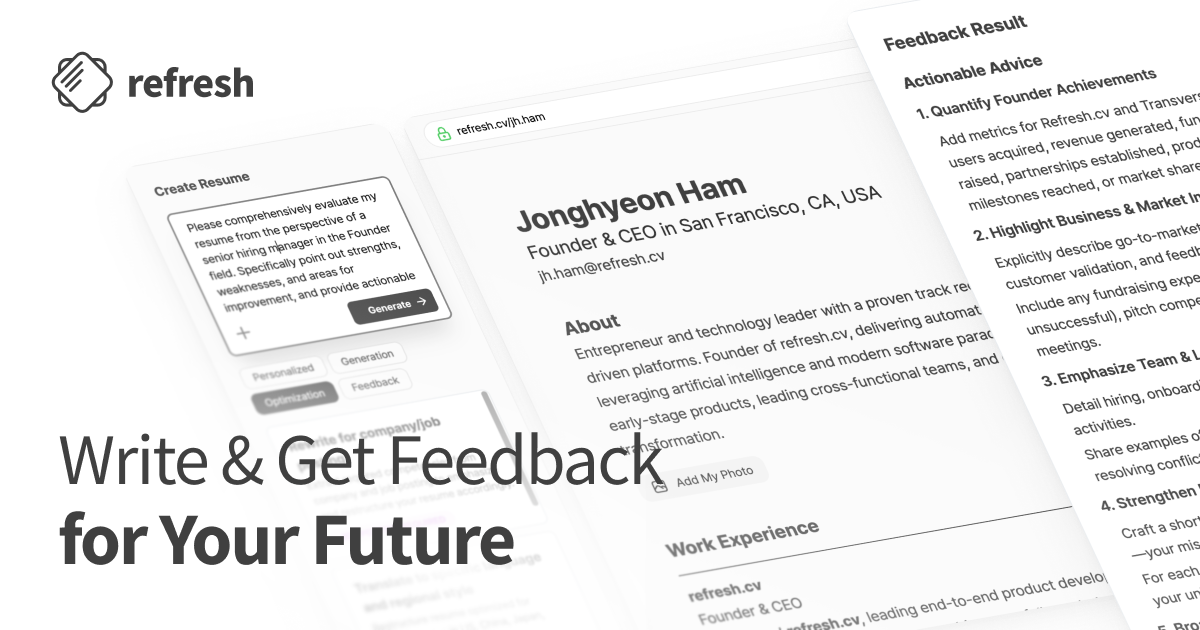
Everything above describes a solid default. Once you are applying to a specific role, that posting's requirements should reshape the order again. That is the workflow refresh.cv runs: paste in the posting, extract its requirements and ATS keywords, compare that language against both the wording and the underlying experience already in your resume, then split every item into three groups. Keyword and evidence both present. Relevant experience present but the posting's exact wording missing. Neither present. The middle group is what moves toward the top of the page. The third group gets left blank rather than invented.
Resume score and job-specific fit are two separate readings. Score analysis looks at specificity, results, wording, and grammar in the document itself. Fit looks at how much of a particular posting's keywords and requirements the resume currently covers. Neither one is a hiring probability or a guarantee of how any employer's applicant tracking system will actually score the document.
On the Free plan you get 5 AI edits and 5 resume score analyses per month. Job-specific tailoring, ATS keyword analysis, and unlimited templates are part of the Pro plan ($14.99/month). Check the pricing page for current plan details before comparing options.
If you are still deciding on a tool, two related reads worth following are our guide on validating a resume tool against a single job posting and our four criteria for a career change resume.
FAQ
I'm a new grad. Won't putting education first make my resume look thin on experience?
Leading with education means showing your strongest verified evidence first. Fill out the rest of the page by listing internships, class projects, and club leadership directly under education as an experience section, rather than leaving it sparse.
Should I include a photo or date of birth on my resume?
Follow whatever the employer's format asks for. US resumes generally skip photos and personal details, while some domestic company templates specifically request them. On a free-form resume with no required template, leaving both off is the safer default.
Can I combine my career narrative into the resume itself?
If the posting only asks for one document, yes. In that case, keep each job's project bullets to around three per company and manage total length so the combined document stays within two pages.
How much detail belongs in the skills section?
Anything that appears in the posting and that you have genuinely used. Star ratings or skill-level graphics are hard to interpret consistently across candidates, so it works better to show your actual proficiency through the context of a work bullet instead.
Do I need to rewrite my whole resume for every job posting?
No. Keep one master resume containing everything, then adjust only the top-section order and which bullets you surface for each posting. That is far more sustainable than a full rewrite each time.
Once you have a specific posting in hand, open refresh.cv and put your current resume side by side with that posting's requirements to see which sentences should move to the top.
0
Get new posts by email
Subscribe to get new articles on resumes, interviews, career moves, and career growth.