Resume Score vs. Job Match: What to Check First?

Instant resume scores usually answer one of two different questions: how well the resume itself is written, or how closely it matches one specific job posting's requirements. Before picking a tool, check whether it also tells you, keyword by keyword, whether your resume already has the experience to back up what's missing. That distinction matters more than how fast the number appears.
Paste a job posting and get back "12 missing keywords," and the instinct is to type all 12 into the resume. That is not the right move. When we compare a job posting's requirements against a resume inside refresh.cv, the first split we make is whether the resume already contains experience that could support each keyword. Two "missing keywords" can need completely different fixes: one is a wording problem; the other has no real experience behind it at all.
Real-time scores measure two different things
Resume Worded scores a resume from 0 to 100 across more than 30 checks and treats 85+ as a strong result. Those checks cover length, bullet length, cliché phrases, passive voice, spelling, and leadership or growth signals, covering how well the resume itself is written overall. Enhancv's resume checker groups 27 similar checks into the same two broad categories.
Jobscan's match rate measures something different. It's calculated against items pulled from the job posting itself (hard skills, job title, education requirements, soft skills), and Jobscan says entering a company name and posting URL lets it estimate which applicant tracking system that employer uses and adjust its formatting advice accordingly. Change the job posting, and the same resume gets a different number.
These two scores answer different questions. A 90 on writing quality still reads as a weak application if it barely overlaps with the posting's requirements. A high match rate paired with vague accomplishment language still loses a human reader once someone opens the file. That's why refresh.cv keeps resume quality analysis (specificity, achievements, wording, grammar) separate from job-specific match scoring instead of folding both into one number.
Three states behind every "missing keyword"
Say a candidate worked as a marketing associate running acquisition campaigns for new sign-ups, but the resume just says "ran online promotions." Depending on what the posting asks for, that gap falls into one of three states.
| State | Example requirement | What's on the resume | Fix |
|---|---|---|---|
| 1. Keyword and evidence both present | Promotion planning | Already described the same way | Leave it alone |
| 2. Evidence exists, wording doesn't match | User acquisition | Campaign experience exists, terms don't line up | Rewrite to match what was actually done |
| 3. No evidence at all | A/B test design | No related experience | Don't fabricate it; strengthen a different requirement instead |
State 2 is just rewriting real work in the posting's own language, so it doesn't change any facts. Filling in state 3 instead means that line comes back as an interview question you can't answer. That's the reason we prioritize state 2 fixes before anything else.
What a 7.4-second scan tells you to fix first
Ladders' 2018 eye-tracking study found that recruiters spent an average of 7.4 seconds on their first pass over a resume. According to HR Dive's coverage of the study, the resumes that held attention in that window had simple layouts and clear section headings, while multi-column formats and long sentences worked against candidates.
That number comes from a small sample of recruiters measured in 2018, so it isn't a constant that applies to every hiring situation today. What it does show clearly is that a first pass mostly registers surface-level text: job titles and section headers. That's the practical reason to fix state 2 (real experience described in the wrong words) before touching anything else on the page.
Five things to check before choosing a tool
- Does it pull requirements and ATS keywords out of a pasted job posting item by item?
- For each missing keyword, does it check whether your resume already has supporting experience?
- Does it keep resume quality scoring separate from job-specific match scoring?
- Are the suggested edits specific (for example, "change this sentence to this") rather than generic advice?
- How many times can you run this workflow on the free plan?
How this works inside refresh.cv
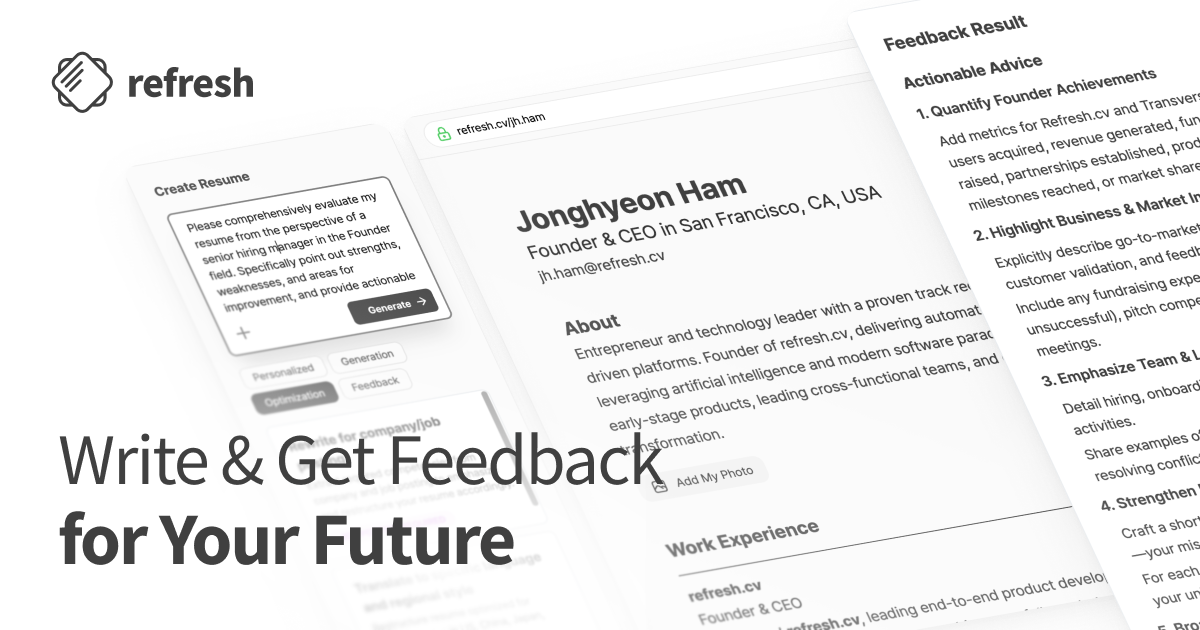
Paste the job posting you're applying to, and refresh.cv pulls out its requirements and ATS keywords, then checks both the wording and the underlying experience evidence in your resume against them, sorting everything into the three states above. From there it suggests what to fix first. It does not suggest inventing experience you don't have, and it does not suggest padding the resume with extra keywords just to raise a count.
On the pricing page, Free includes 5 AI writing/editing actions and 5 resume score analyses per month, plus starter templates and a shareable resume page. Pro is $14.99/month and adds job-specific resume tailoring, ATS keyword analysis with improvement suggestions, and unlimited resume and cover letter AI actions and templates. Max is $49.99/month and adds priority access to newer models plus 50 Mock Apply sessions per month. Mock Apply works best after tailoring is done, as a check on application readiness rather than the main event.
What no score can tell you
No score guarantees a resume clears an application. Jobscan's own guidance notes that some resumes end up over-optimized, and that pushing past 75% match without visibly stuffing keywords can be difficult in some cases. Chasing the number as a goal produces an unnatural document, and that costs ground once a person actually reads it.
The real value of real-time feedback is knowing what to fix next. Matching the wording on items you already have evidence for, and leaving the rest blank, produces a resume you can actually defend in an interview.
FAQ
Should I prioritize the quality score or the match score first?
If you already have a job posting in mind, start with the match score. Fix items where you have real experience but mismatched wording first, then refine quality items like achievement numbers and sentence structure - that order wastes less effort.
What do I do about keywords I have no experience for?
Leave them off the resume. Instead, sharpen the wording on requirements you can genuinely back up, or look at postings that weight that particular skill less heavily.
Can I test this workflow on a free plan?
Yes. Free includes 5 AI writing/editing actions and 5 resume score analyses per month, enough to see how the workflow works. Repeating job-specific tailoring, ATS keyword analysis, and improvement suggestions regularly requires Pro or higher.
Does the same standard apply to English-language resumes?
The underlying approach (pulling out requirements and checking them against real experience evidence) is the same. Job titles and technical terms vary by market, though, so it's safer to match the exact phrasing used in postings in the country you're applying to.
Paste one job posting you're actually applying to into refresh.cv and see how it splits into these three states.
0
Get new posts by email
Subscribe to get new articles on resumes, interviews, career moves, and career growth.