How to Choose an AI Resume Builder for a Career Change

Picking a resume builder for a career change comes down to four checks: does it pull requirements and ATS keywords straight from the job posting, does it separate a wording problem from a missing-experience problem, does it tell you which fix matters most, and how far does the free tier actually let you go before you pay. This guide compares refresh.cv, Rezi, Teal, and Kickresume against their own pricing pages, then walks through a backend-engineer-to-product-manager rewrite.
Recruiters do not read a resume the way a candidate hopes they will. Ladders' eye-tracking research put the initial screen at an average of 7.4 seconds, and a more recent 2024 survey found 47% of hiring professionals still spend under a minute reviewing one, according to an aggregated review of recruiter screening-time research by Standout-CV. That screen rewards whichever resume shows the clearest match to the posting, regardless of how compelling the rest of the career story is.
Career changers lose that first screen for a specific reason. Resume.io's career-change guide points out that people switching fields tend to keep the vocabulary of their old job, list duties instead of results, and lean on formats that obscure their work history instead of connecting it to the new role. A resume builder's real value is translation: turning existing experience into the employer's vocabulary. Check for that specific capability before you commit to one.
Criterion 1: Does It Pull Requirements and ATS Keywords From the Posting?
Start with one job posting, not a generic template. A tool that reads the actual posting can separate required qualifications from preferred ones and surface the specific tools and terms the employer repeats. A tool that only offers role-average suggestions skips the one thing a career changer needs most: the exact language this employer used.
This matters because generic resumes are themselves a common failure mode. A one-size-fits-all resume buries relevant keywords and experience, and recruiters scan the top third of the page for role-specific alignment before reading further. If a career changer submits the same resume to five different postings, none of them will read as a close match, no matter how strong the underlying experience is.
Criterion 2: Does It Separate a Wording Gap From an Experience Gap?
Matching keywords in a document is not the same as confirming you have the evidence behind them. For a career change, that distinction decides how you spend your editing time. Sort every requirement in the posting into one of three buckets:
- Keyword and evidence present — tighten the sentence with a number, a timeframe, or a specific outcome.
- Relevant experience present, wording missing — rewrite the sentence in the posting's language without changing what actually happened.
- Neither present — leave it out. Free up the space for a requirement you can actually back up.
The second bucket is where a career-change resume gains or loses the most ground. Turning "managed store-level sales performance" into "owned onboarding and retention outcomes for assigned accounts" works as translation into the hiring manager's vocabulary, provided the underlying work actually supports the claim. Filling the third bucket with a tool you have never touched is the opposite move, and it tends to backfire in the same conversation where it was supposed to help: the follow-up question in an interview lands on the exact sentence you can't defend.
Criterion 3: Does It Tell You What to Fix First?
A report with forty flagged issues is not useful if you can only realistically fix five before you submit. Check whether the tool ranks its suggestions, prioritizing requirements marked as mandatory in the posting, the top third of the resume that a recruiter actually reads, and any results-oriented line that is missing a number.
It also helps to know that resume quality and job-posting fit are separate measurements, each capturing something different about the document. Quality covers specificity, achievement framing, wording, and grammar as properties of the document itself. Fit measures how well that same document matches one posting's stated requirements. A resume can score well on quality and still miss a specific posting's requirements, and a tool that reports both separately is more useful than one that folds them into a single number. refresh.cv's breakdown of feedback layers covers this distinction in more depth.
Free Tiers, Compared Against Official Pricing
The existence of a free plan matters less than what you can actually test on it. The table below reflects what each vendor states on its own pricing page; features and prices change, so confirm the current numbers before you commit to a paid tier.
| Service | Official monthly pricing | What the free/entry tier includes, per the vendor |
|---|---|---|
| refresh.cv | Free $0 / Pro $14.99 / Max $49.99 | Free includes AI resume and cover letter edits and resume score analysis, each capped monthly, plus a capped number of PDF downloads. Job-specific resume tailoring and ATS keyword analysis are part of the Pro tier ([pricing](https://refresh.cv/pricing)). |
| Rezi | Free $0 / Pro $29 / Lifetime $149 one-time | Free covers one resume and a limited set of AI features; Pro unlocks the full feature set plus a monthly expert review (pricing). |
| Teal | Free plan + paid Teal+ (price varies by billing cycle) | Teal+ is where the full AI resume builder, unlimited resume analysis, and keyword matching live, per Teal's own pricing page (pricing). |
| Kickresume | Free plan + Premium (price varies by billing cycle) | The ATS Resume Checker for format compliance and comparison against a database of resumes that reportedly succeeded sit behind Premium (pricing). |
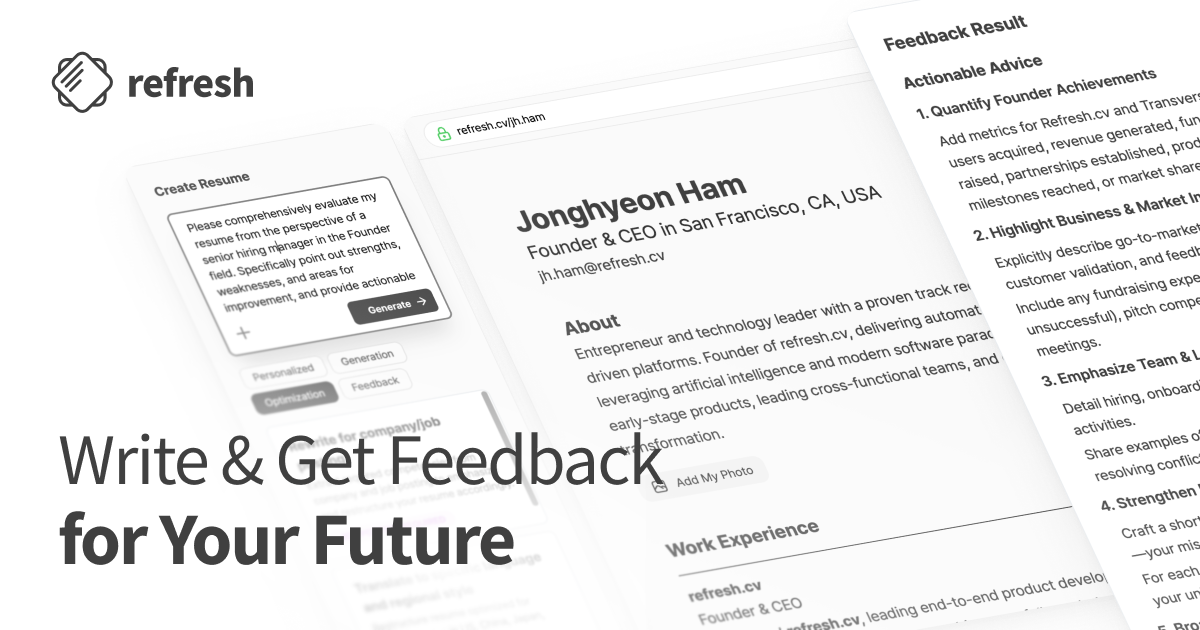
Read the free-tier column carefully. Rezi states its free plan directly on its pricing page. Teal and Kickresume vary their paid pricing by billing cycle on their own sites, so a screenshot from a few months ago may already be stale. refresh.cv separates its plans the same way: quality feedback and a first tailoring pass are available for free, while job-specific tailoring against a real posting and full ATS keyword analysis sit in the paid Pro tier.
A Worked Example: Backend Engineer to Product Manager
Suppose a posting reads: "define requirements based on user research, build and prioritize the roadmap, coordinate specs with the engineering team, and use data tools such as SQL and Amplitude." The candidate is a five-year backend engineer whose current resume lists "designed API architecture and backend systems," "ran weekly sprint retrospectives," and "handled incident response and troubleshooting."
- Keyword and evidence both present: coordinating specs with engineering. The existing line "ran weekly sprint retrospectives" becomes "led weekly spec reviews and feature-priority discussions with the engineering team," which states the frequency and the candidate's actual role in the conversation instead of just naming a meeting.
- Experience present, wording missing: roadmap prioritization. Pull the prioritization-related portion out of "designed API architecture and backend systems" and rewrite it as "contributed to quarterly feature prioritization and roadmap planning." If there's an incident-response track record, split it into its own data-analysis line: "built monitoring dashboards from incident-log analysis to track service metrics."
- Neither present: SQL and Amplitude specifically. If the candidate has never used either tool, leave them out rather than list them. If a comparable tool was actually used, name that tool instead: "used Grafana and Datadog to monitor service metrics and detect anomalies" is a real, defensible claim; claiming unfamiliar tools by name is not.
Once this pass is done, the resume's summary and most recent role read in the posting's language instead of the old job's language. If you're applying to more than one posting like this in the same search, refresh.cv's guide to comparing tools for a working professional covers keeping multiple tailored versions straight without losing track of which claims go with which job.
What a Resume Score Can't Tell You
No resume tool's score reflects an actual hiring decision or a specific employer's ATS result. A score is an estimate of how explicitly a document states the requirements it's being measured against, nothing more. Given how briefly a recruiter's first pass tends to run, making sure the top of the resume states relevant experience in the posting's own terms matters more than chasing a higher number.
One test works better than watching a score climb: can you explain the rewritten sentence out loud in an interview for five minutes? If yes, keep it. If you stumble, the claim doesn't have evidence behind it yet, and it should go back to bucket three until it does.
FAQ
Can the free plan alone get a resume tailored to a specific job posting?
It depends on the tool. Whether job-specific tailoring and ATS keyword analysis sit in the free tier or the paid tier varies by vendor: check refresh.cv's pricing page, Rezi's pricing page, and Teal's pricing page directly. If the free tier doesn't cover it, a one-month paid plan during a busy application stretch is a reasonable middle ground.
Do career-change bullets need a number in every line?
Only where you have a real number to put there. Deal counts, project timelines, retention or conversion figures you can personally back up come first. Treating an estimate as a confirmed result invites a follow-up question you can't answer cleanly, which does more damage than leaving the line unquantified.
Should experience unrelated to the new field be deleted?
Keep it if removing it would leave an unexplained gap, but shorten it. The evidence above points to generic, unfocused resumes and mismatched requirements as recurring failure points, not the mere presence of an old job title. Give the unrelated role a line or two of fact and put the freed-up space toward experience that maps to the new posting.
Does a higher resume score mean a better chance of getting hired?
Quality score and job-posting fit measure different things: quality is a property of the document itself, and fit is a property of its match to one posting. Use the score to confirm you've stated your real experience clearly, not as a predictor of a hiring outcome or a specific employer's ATS decision. Use the score to confirm you've stated your real experience clearly and completely against a posting's requirements, not as a target in itself.
Have a specific posting in hand? Run it against your current resume on refresh.cv to see where the requirements and ATS keywords line up with your actual experience, and where they don't yet.
0
Get new posts by email
Subscribe to get new articles on resumes, interviews, career moves, and career growth.