Developer to Product Manager: What to Keep on Your Resume
Moving from software development into product management? Start by identifying the target job description's requirements and ATS keywords. Compare them with your resume wording and actual experience evidence, then prioritize revisions that make your relevant work clear without overstating your role.
Quick answer: Keep experience that explains user problems, prioritization decisions, stakeholder collaboration, and verified results. Trim implementation details that do not help explain those decisions. Do not erase your engineering background or replace your developer title with a product manager title.
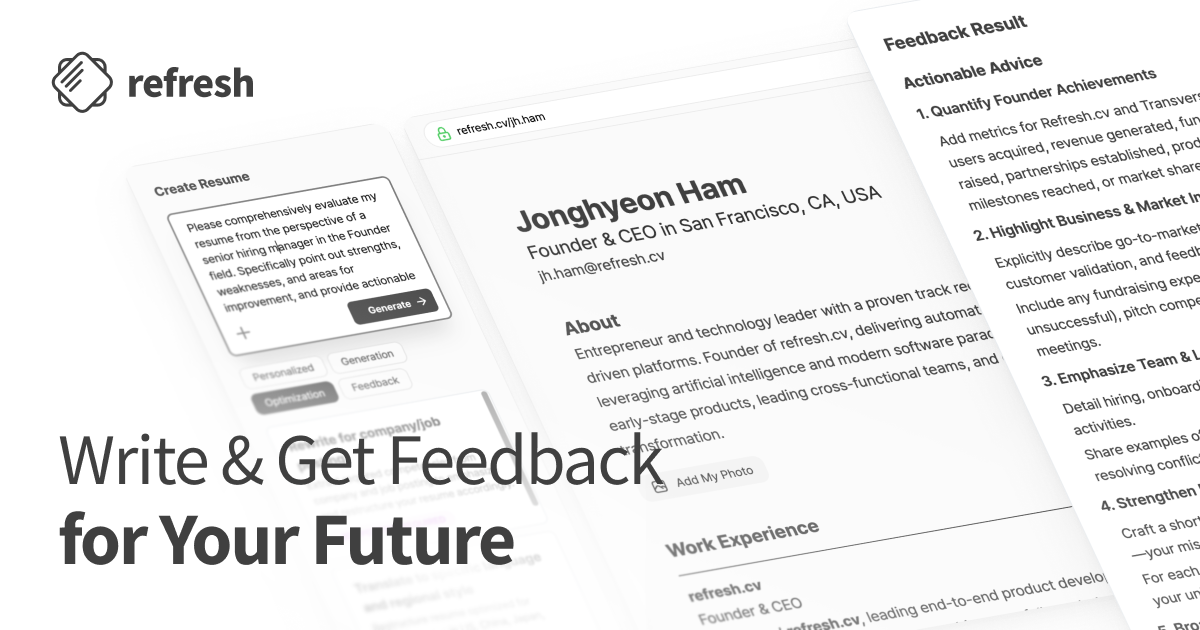
Here, PM means product manager. The editing question is not whether an experience counts as development work. It is what that experience demonstrates about the product work in the role you want. The job-specific resume workflow at refresh.cv follows the same principle: connect the job description's requirements and ATS keywords to experience you can substantiate.
Use the PM job description to choose what stays
Treat the following table as an editing framework, not a universal checklist for every product management role. Start with the requirements in your target posting, then look for corresponding evidence in your projects.
| What the job description asks for | Evidence to look for in development projects | What to keep on your resume |
|---|---|---|
| Problem definition | Your review of support inquiries, usage records, or errors | Whose problem you identified and how you confirmed it |
| Prioritization | Records of comparing alternatives and costs or proposing scope | What you recommended doing first and why |
| Stakeholder collaboration | Requirements discussions with product, design, or operations | The disagreement or constraint, the agreement reached, and your contribution |
| Evaluating results | Measurements before and after release or operational records | The verified outcome and its measurement conditions |
| Technical understanding | Experience explaining technical constraints and evaluating alternatives | Technical judgment that affected a product choice |
Before selecting projects, write down the actions you actually took that fit these areas. You do not need to fill every row.
If a posting calls for technical understanding of API products, keep relevant design experience. Condense library configuration details that do not explain a user problem or product decision. Technical difficulty alone should not determine how much space a project gets.
Keep the connection between problems, decisions, collaboration, and results
Organize a project around this sequence: evidence of the problem → your judgment and actions → collaboration → verified results. A missing part is something to investigate, not something to invent.
- How you learned about the problem: If you reviewed support inquiries shared by operations, say that. Do not turn it into leading user research if you did not conduct interviews.
- Why you proposed an option: Keep the alternatives you considered and the reason for your recommendation, rather than listing only implementation choices. Distinguish proposing a decision from making the final decision.
- What you coordinated: Replace “collaborated cross-functionally” with the people, requirements, or constraints involved. Attending a meeting is not the same as leading an agreement.
- What you verified: If you measured response time, report response time. Do not turn it into revenue growth or a conversion increase without supporting evidence.
For any metric, check the measurement period, what was measured, and the conditions. If you do not have a number, use a verifiable outcome such as a completed release or an agreed implementation scope. Do not estimate an improvement percentage to fill the gap.
Separate team outcomes from your contribution. If the team shipped a feature and you proposed and implemented its error-handling flow, state those facts separately. Do not rewrite them as “owned the product launch.” Keep company names, job titles, and employment dates accurate. Explain your specific role in the project description.
Trim technical inventories and inflated ownership claims
You do not need to remove your entire tech stack. Keep technologies that are relevant to the posting or explain a decision. Start by cutting sentences that repeat the same experience.
| Resume content | How to edit it |
|---|---|
| A long tech stack list | Put relevant technologies first and condense the rest. |
| Repeated feature implementation descriptions | Group similar work and preserve distinct examples of judgment. |
| Detailed configuration or method descriptions | Keep only the detail needed to explain the user problem or technical constraint. |
| Strategy or roadmap ownership you did not have | Remove it and describe what you actually proposed, reviewed, or implemented. |
A performance improvement project is not something to remove just because it is technical. Check whether you can explain the problem it addressed and whether you helped make the case for prioritizing it.
If you were not involved in those discussions, describe the implementation accurately. A posting that mentions “prioritization” is not a reason to add decision-making experience you do not have.
Before and after: reframe the same development experience
The following is a hypothetical project, not a claim about a real candidate. Before using any part of it, check every action and result against your own records.
Before: implementation only
Developed an order-history API. Added caching and optimized database queries.
This tells the reader what was built, but not whether the developer investigated a user problem or contributed to prioritization. Before rewriting it, check support records, proposals, and discussion notes:
- Did you personally review the inquiries shared by operations?
- Did you distinguish difficulty understanding order status from slow retrieval?
- Did you compare a screen redesign with improvements to status display and retrieval performance?
- Who made the final scope decision, and what did you propose?
If you actually reviewed the inquiries, proposed an alternative, agreed on scope with a product colleague, and implemented the API changes, you could write:
After: evidence-based framing
Reviewed order-status inquiries shared by operations and identified unclear status information and slow retrieval as issues to address. Proposed improving status display and retrieval performance before a full screen redesign, and agreed on implementation scope with a product colleague. Implemented caching and database query optimizations for the order-history API.
The rewrite preserves the context, problem, your actions, collaboration boundary, and technical contribution. It states the agreed scope without inventing a numerical scale or a measured improvement.
It does not claim that you made the final prioritization decision or that customer inquiries decreased. If you only implemented the API changes, use only the final sentence. Reframing experience is different from adding experience.
Separate keyword gaps from experience gaps
In refresh.cv, paste your target PM job description to extract its requirements and ATS keywords. Compare them with your resume wording and actual experience evidence, then review missing keywords, unmet requirements, and revision priorities. Use the following three states to decide what to revise first, keeping every change grounded in work you actually did.
The keyword and supporting evidence are both present
Make the evidence easier to understand. Clarify who you worked with, what you did, and where your responsibility began and ended.
In the example above, the collaboration is not simply “worked with product.” It is agreeing on the scope of a proposed improvement with a product colleague.
Relevant experience is present, but the keyword is missing
Use the job description's language where it accurately describes your work. Make your proposal, comparison of alternatives, or scope discussion explicit.
Do not turn a contribution to a decision into final decision-making authority. The goal is to surface existing experience, not enlarge it.
Both the keyword and supporting evidence are missing
Do not add a phrase such as “product strategy” on its own. First check whether you left out a real experience that supports it. If the required experience is genuinely missing, a wording change does not satisfy that requirement.
Keep resume quality separate from job-specific fit. Specificity, achievements, wording, and grammar are one assessment. Alignment with a posting's keywords is another. A polished sentence does not establish that you have the experience a job requires. Neither assessment represents a hiring probability or the employer's actual ATS decision.
Check the resume before you submit
- Keep your history accurate: Preserve company names, job titles, and employment dates.
- Match requirements to evidence: Make relevant problem-solving, judgment, and collaboration visible.
- Respect ownership boundaries: Distinguish what you proposed, what you decided, and what you implemented.
- Verify outcomes: Use only results and measurement conditions you can support.
- Trim selectively: Keep technical details that explain the target role's requirements or your decisions.
Compare your target PM job description with your current resume in refresh.cv. Before deleting your development experience, bring forward the problem-solving and collaboration you actually did but have not yet made clear.
0
Get new posts by email
Subscribe to get new articles on resumes, interviews, career moves, and career growth.