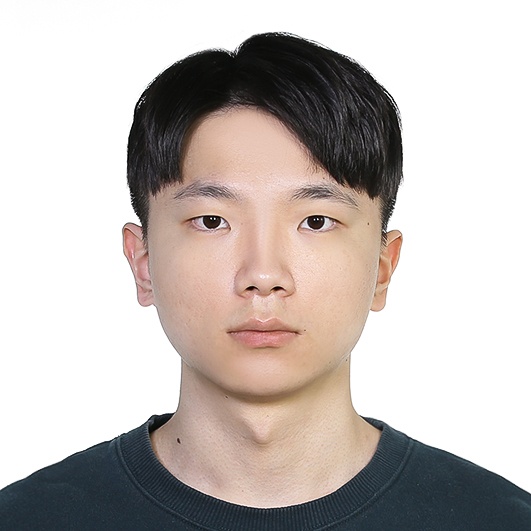
Jaehyun Jeong
jj.for.jaehyun@gmail.com
Bachelor of Science in Applied Mathematics, Kongju National University (Feb 14, 2025)
Yamaguchi University (Faculty of Science): non-degree visiting student, April 2023–March 2024; completed 33 credits in analysis, algebra, computer science, statistics, modeling, and simulation.
Interests include reinforcement learning (RL) and AI based on fundamentals in Markov Decision Processes, optimization, and programming.
Selected coursework: Deep Learning; Advanced Calculus I–II; Applied Linear Algebra I–II; Probability and Statistics; Data Structures and Algorithms; Programming for Data Science; Artificial Intelligence and Mathematics; R Programming.
Experience with: RL Algorithms (PPO, DQN, A2C, REINFORCE), Planning/Control (MPC), Time Series Forecasting, Image Classification, NLP (Basic concepts to Transformer)
경력
GlucoUS
Gongju-si, Chungcheongnam
CTO & Co-founder
2025년 7월 - 현재
- Designed the MySQL schema and REST APIs; set up CI/CD with automated deployments, health checks, and monitoring.
- Prototyped a simple recommendation and glucose-forecast model using minimal inputs; explored safe personalization under sparse data.
- Selected for the Asan Nanum Foundation “Doers” Program — Pre-Startup Track (Jeong Joo-Young Startup Competition).
AI Playground
Yamaguchi, Japan
AI Tech Lead
2023년 5월 - 2024년 3월
Led development of ML learning modules and reference implementations (k-NN, logistic regression, decision trees) with tests and documentation from scratch.
Produced animated explainers with Manim(3blue1brown math tool); set code review standards for reproducibility.
Supported curriculum design, demo pipelines, and contributor workflows.
Kongju National University
Gongju-si, Chungcheongnam-do, Republic of Korea
Undergraduate Researcher, AI-integrated Physics Lab
2024년 9월 - 2025년 2월
Participated in the KIAS workshop titled “Machine learning integrated Fourier transform for enhanced signal analysis,” exploring ML-driven spectral methods.
Studied and conducted experiments on the double descent phenomenon, analyzing weights dynamics across model capacity and sample regimes.
학력
Kongju National University
Gongju-si, Chungcheongnam
Applied Mathematics
2019년 3월 - 2025년 2월
Bachelor of Science in Applied Mathematics; Graduation: February 14, 2025; 130 credits; GPA: 3.81/4.5 (93%).
Core coursework: Advanced Calculus I/II, Applied Linear Algebra I/II, Applied Differential Equations, Probability Theory, Probability and Statistics, Discrete Mathematics, Artificial Intelligence and Mathematics, Deep Learning, R Programming, Data Structures and Algorithms, Modeling and Simulation.
Yamaguchi University
Yamaguchi, Japan
Exchange Student
2023년 4월 - 2024년 3월
Faculty of Science; Non-degree exchange; Apr 2023–Mar 2024; 33 credits.
Studied analysis, algebra, probability and statistics, data structures, programming for data science (RL lecture), modeling and simulation, graph theory.
기술
Programming Languages
- Python (NumPy, Pandas, SciPy) for data analysis and prototyping
- C++ for performance-focused tasks
- C for basic systems programming
- R (tidyverse) for statistics and plots
Machine Learning & Deep Learning Frameworks
PyTorch
TensorFlow/Keras
scikit-learn
PyTorch Lightning
Data Science & Tools
Jupyter Notebook
RapidMiner/tableau
MATLAB
RStudio
Relevant coursework: Data Structures and Algorithms; Programming for Data Science; Applied Data Science Practice; Seminar in Multimedia Processing; Computer Programming II; Deep Learning
Version Control & Collaboration
Git
Notion
Asana
Reinforcement Learning
Familiar with PPO, SAC, A2C, and DQN
Understand MDPs, policy/value methods, reward design, and exploration basics
Used PyTorch, Gym/Gymnasium
AI Experimentation & MLOps
- Track experiments with Weights & Biases, MLflow, and TensorBoard
- Hyperparameter tuning with Optuna
- Export and run models with ONNX and TorchScript
Mathematics & Statistics
Calculus
Linear Algebra
Convex Optimization
Statistics
Probability Theory
Graph Theory
Multivariate Analysis
Modeling and Simulation
Group, Ring Theory
오픈소스
GRLL: General Reinforcement Learning Library
Independent
Engineered and modularized core deep reinforcement learning algorithms (DQN, Averaged-DQN, A2C, REINFORCE) in PyTorch, designing extensible value-based and policy-gradient architectures.
Benchmarked GRLL against Stable-Baselines3 (SB3) on representative RL tasks; observed faster training and simpler implementation.
Created OpenAI Gym–compatible environments and wrappers that enable vectorized rollouts, batched sampling, and reward shaping for controlled experimentation.
Enabled real-time diagnostics and performance monitoring with TensorBoard.
2022년 5월 - 2022년 11월
Reinforcement Learning Lecture Development
Kongju National University
Supported lecture materials covering MDPs, Bellman equations, value iteration, policy gradients, and actor–critic basics.
Prepared Conda environments and PyTorch training scripts for hands-on exercises with reproducible settings.
Created simple plots for learning curves and policy evaluation to aid understanding.
2022년 3월 - 2022년 7월
프로젝트
Data Science Creator Camp: Image Classification (2nd Place)
DCC
2022년 10월 - 2022년 11월
Completed a one-month intensive on the end-to-end deep learning workflow. From data analysis and cleaning to preprocessing, model training, and evaluation.
Implemented ResNet and VGG variants and set up preprocessing (normalization, resizing) with basic augmentation.
Built advanced architecture of VGG, improving accuracy.
Built a PyTorch training and evaluation pipeline with adjustable hyperparameters and run tracking.
Agricultural Product Price Prediction Competition (15th of 550)
galmingalmin
2024년 10월 - 현재
Compared XGBoost, CatBoost, and regularized linear models; selected the best-performing approach on validation.
Set up a time-series workflow with rolling cross-validation and leakage-aware feature engineering.
2nd Anomalous Diffusion (AnDi) Challenge (12th Place)
KNU-ON
2023년 12월 - 2024년 7월
- Built a sequence model combining 1D CNN, BiLSTM, attention, and MLP for trajectory data.
- Applied attention-based sequence learning to capture temporal patterns in trajectories.